
You pay for Xero every month, yet you may still feel you are barely using it. Reports go unread, bank feeds drift out of reconciliation, and the true state of your finances only becomes clear when a GST deadline or year-end forces the issue. For many Singapore SMEs, this is rarely a software problem. Finance keeps slipping down the list because time is short, and handling it yourself between everything else tends to cost more than it saves. The better question is who is running it, and how. A capable Xero accountant does far more than enter transactions and file returns. The right partner treats Xero as a system to be designed around your business, not a box to be ticked. This guide explains what a good Xero accountant actually does, why the cost objection usually misses the point, how the Xero app ecosystem unlocks far more value, and how to choose a partner who will help your finances scale.
What a Xero accountant actually does
A Xero accountant is an accountant or firm that is specialized in Xero. The day-to-day work covers bookkeeping, bank reconciliation, GST preparation, payroll coordination, and management reporting.
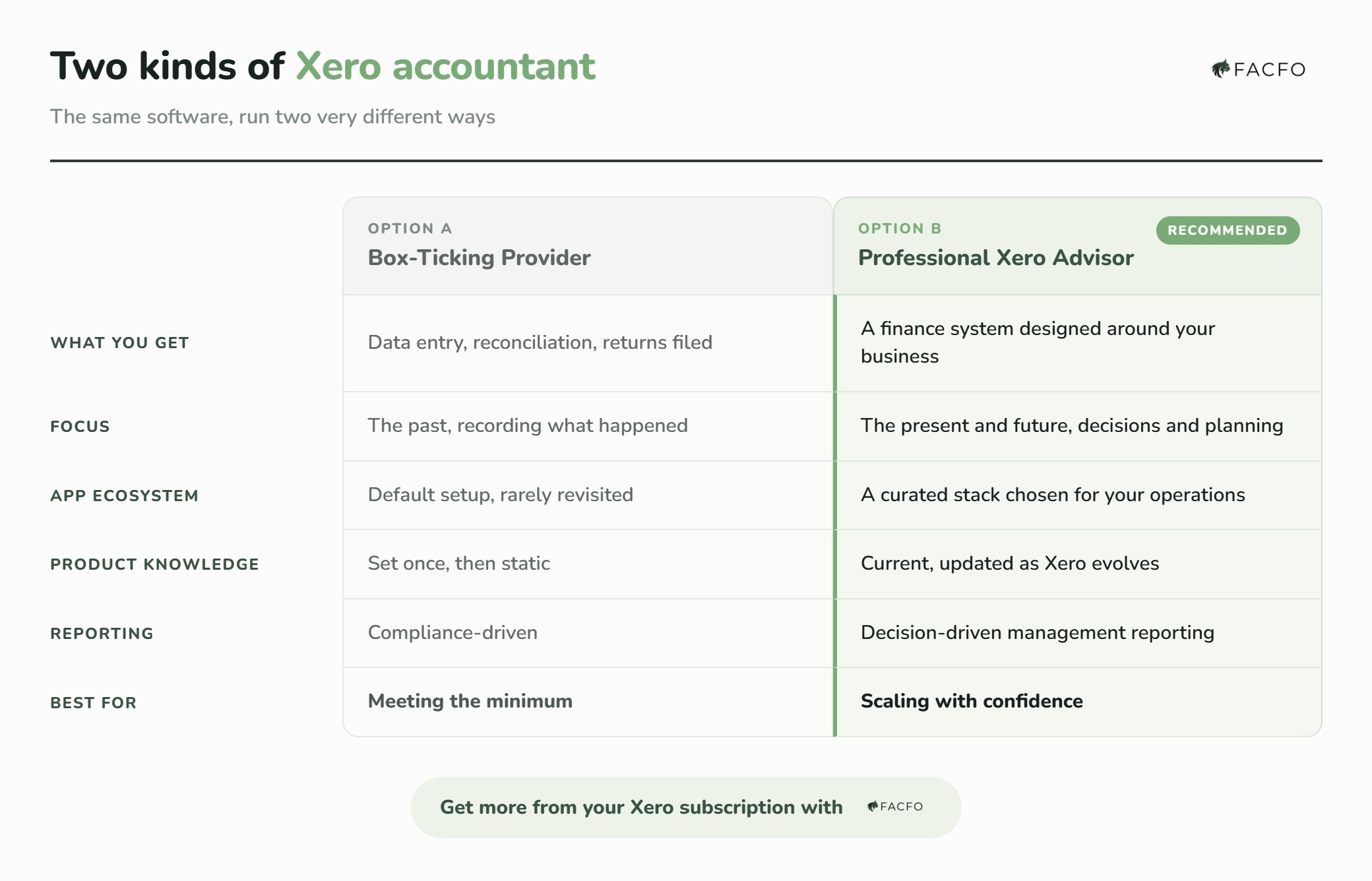
That description fits two very different kinds of provider, though, and the difference matters to your bottom line. One simply records what has already happened: data entry, reconciliation, and a return filed on time. The other designs how your finances run, where automation removes manual work and enhances accuracy, and how the numbers turn into decisions you can act on. Both will call themselves a Xero accountant. Only the second earns the fee.
Why “Xero is expensive” is usually the wrong question
Spend any time in Singapore SME forums and you will find the same complaint: Xero feels expensive. It is a fair observation if you treat the subscription as a cost with no return. A ledger you log into twice a year is poor value at any price.
The waste, however, is rarely the subscription itself. It is paying for a capable platform and using only a fraction of it. Xero is a strong engine in its own right, and it handles a great deal without help. When you need something more sophisticated, you can draw on its vibrant ecosystem of connected tools.
The real gap sits between what Xero can do and what most owners know how to use. Measured against the hours saved and the better decisions made, the monthly fee is usually the smallest number in the equation. The job of a good Xero accountant is to close that gap, turning what you already pay for into what you actually use.
Consider a common scenario. A growing services firm in Singapore keeps Xero, but a director still enters supplier bills by hand, exports figures into a spreadsheet each month, and only notices slow-paying clients when cash runs tight. The subscription looks like dead weight. In practice, the same platform could capture those bills automatically, chase overdue invoices without anyone lifting a finger, and show the live cash position across every bank account. Nothing about the software changed. What changed was the decision to use it properly.
Getting more out of Xero: the app ecosystem
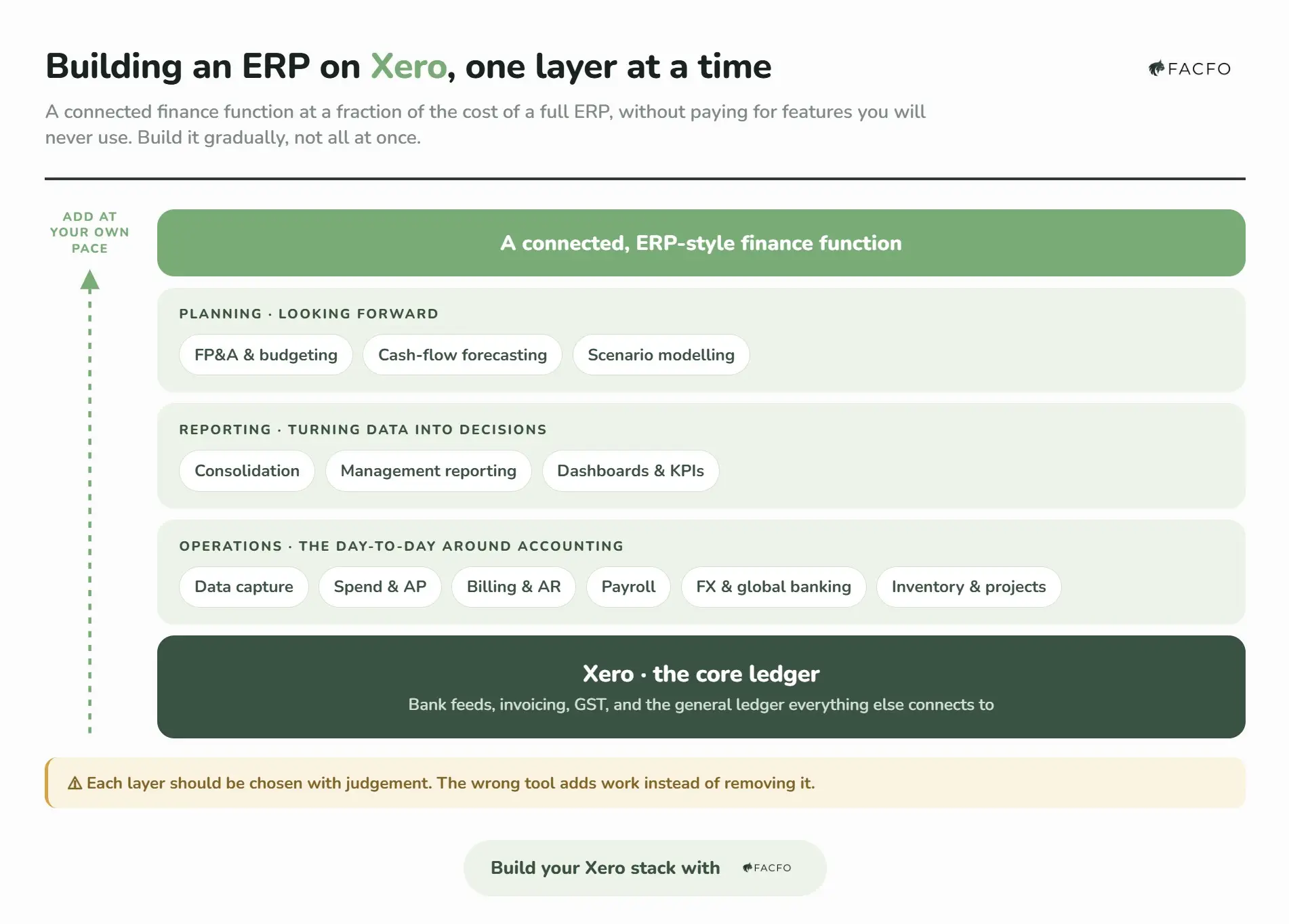
This is where an experienced partner earns their keep. Xero is not a closed system. It sits at the centre of an open ecosystem of more than 1,000 connected apps, spanning payments, document capture, expense management, inventory, payroll, and reporting. You can browse them in the Xero App Store.
Used well, those apps let you assemble something close to a modern ERP, one building block at a time, at a pace your business can absorb. Document capture tools remove manual data entry. Reporting and forecasting tools turn the ledger into forward-looking insight. Receivables tools automate the chasing of overdue invoices. Approval tools add financial controls as your team grows.
The value is not in knowing these names. It is in understanding the consequences of each choice: how one app affects another, where two tools overlap, and which combination fits the way your business actually operates. A partner who works with these products daily, and who stays current as they change, will design a stack that fits you rather than forcing you into a template. That is the difference between buying software and building a finance function.
Done well, this is what lets a small business punch above its weight. A large company buys an expensive, all-in-one ERP system and absorbs a long, costly implementation. With Xero, you can reach a similar outcome gradually, adding one capability when you need it and the next when you are ready. You get there at a fraction of the cost, you never pay for features you will never use, and you are not locked into a single vendor’s roadmap. The trade-off is that the building blocks have to be chosen and connected with judgement. Add the wrong tool, or connect two that fight each other, and you create new manual work rather than removing it. This is also why outsourced bookkeeping worth more when the person running it knows the platform in depth.
Reporting shows how far this can go. Xero’s own customisable reports already give a clear read on performance. When you need more, Syft Analytics, now owned by Xero, turns the same data into live, interactive dashboards and management reports, closer in feel to a business intelligence tool such as Tableau than to a standard accounting export.
Through a Xero partner, Syft can sit alongside your Xero plan, and it can be configured so the people who need numbers never have to log into the accounting software. A department head, for instance, can be given a clear, automatically updated view of the revenues and expenses that fall within their remit, without a Xero login and without wading through the rest of the ledger. That kind of tailored reporting is exactly what an experienced partner can design around your business.
Xero and Singapore compliance: GST F5 and InvoiceNow
Getting more from Xero is not only about efficiency. It is increasingly about staying compliant. Xero handles GST F5 preparation and supports Singapore’s shift to mandatory e-invoicing through InvoiceNow, Singapore’s national e-invoicing network, introduced by the Infocomm Media Development Authority (IMDA) in 2019.
The Inland Revenue Authority of Singapore (IRAS) is phasing in the GST InvoiceNow requirement. Newly incorporated companies that register for GST voluntarily have been in scope since 1 November 2025, and from 1 April 2026 the requirement extends to all new voluntary GST registrants, regardless of incorporation date or business structure. Existing GST-registered businesses will follow in stages between 1 April 2028 and 1 April 2031, based on their annual supplies.
Xero is an InvoiceNow-ready solution, but readiness on paper is not the same as a clean setup. An accountant who understands both Xero and the requirement can configure your system so invoice data transmits correctly the first time, rather than leaving you to fix it under a deadline.
How to choose a Xero accountant in Singapore
A low price and a Xero logo on a website tell you very little. These questions reveal whether a provider will run Xero as a system or simply as a filing tool:
- Do they ask about your business before recommending a setup? A partner who designs around your needs will want to understand your operations first.
- How well do they know the Xero app ecosystem? Ask which apps they would consider for your situation, and why.
- Do they stay current? Xero and its apps change often. A good partner follows product developments rather than relying on a setup built years ago.
- Can they explain the trade-offs? A strong answer covers what an option costs you, not only what it does.
- Are they fluent in Singapore compliance? GST, InvoiceNow, and statutory reporting should be second nature.
- Are they Xero-certified, and can they point to real client work? Certification is a baseline, not a guarantee.
- Will their reporting help you decide? Management reporting should drive decisions, not just close the books.
The bottom line
Xero is a powerful, scalable platform, but its value depends almost entirely on how it is run. Treated as a monthly bill and a box to tick, it will feel expensive. Treated as a system, designed around your business and connected to the right tools, it becomes the backbone of a finance function that grows with you. Choosing the right Xero accountant in Singapore is less about the lowest price and more about depth: ecosystem knowledge, current product understanding, and a willingness to build around your needs rather than a template.
If you would rather not navigate this alone, we are here to help. Book a no-obligation call, and we will show you where your Xero setup could be working harder.