
Bookkeeping is the process of recording every financial transaction your business makes. Every sale, every expense, every payment received, and every invoice sent needs to be captured, classified, and stored in an organised way. It sounds straightforward. In practice, it is often the first thing that falls behind when a business gets busy, and the consequences of that can surface at the worst possible moment.
For small business owners in Singapore, bookkeeping is not just a useful habit. It is a legal requirement. The Inland Revenue Authority of Singapore (IRAS) and the Accounting and Corporate Regulatory Authority (ACRA) both require businesses to maintain proper financial records, and there are specific standards for what those records must include. Getting this wrong, or simply getting behind on it, creates compliance exposure that can be difficult and expensive to fix.
This article explains what bookkeeping is, why it matters for small businesses, and why handling it yourself, without an accounting background or proper systems in place, usually creates more problems than it solves.

What Does Bookkeeping Actually Involve?
At its core, bookkeeping for small businesses means recording the day-to-day financial activity of your business in a systematic way. This includes:
- Recording income from sales and services
- Tracking expenses, from rent and utilities to software subscriptions and staff costs
- Managing accounts receivable (money owed to you) and accounts payable (money you owe)
- Reconciling your bank and credit card statements against your records
- Maintaining supporting documentation for every transaction
Good bookkeeping gives you an accurate picture of your financial position at any point in time. It also forms the foundation for everything that follows: tax filing, financial reporting, management decisions, and investor or lender conversations.
Without clean books, none of those activities can be done reliably.
Cash Accounting vs Accrual Accounting: Why the Distinction Matters
One of the first concepts that trips up business owners who manage their own books is the difference between cash accounting and accrual accounting. The distinction affects both how revenue is recognised and how expenses are recorded, which means the two methods can produce materially different results from exactly the same set of transactions.
Cash Accounting
Under cash accounting, you record revenue when you receive payment and record expenses when you make payment. If you invoice a client in March but they pay in April, you record the revenue in April. Similarly, if you receive a supplier invoice in March but pay it in April, the expense sits in April. This approach is simple and reflects your actual cash flow, but it can significantly distort the picture of financial performance, particularly when there are timing gaps between invoices raised and cash received or paid.
Accrual Accounting
Under accrual accounting, you record revenue when it is earned and expenses when they are incurred, regardless of when cash changes hands. If you complete a project in March and invoice the client, the revenue belongs to March, even if payment arrives in April. Likewise, if you receive a rent invoice for March and pay it in April, the expense sits in March. This is the method required under the Singapore Financial Reporting Standards (SFRS), which apply to companies incorporated in Singapore. Under SFRS, revenue is recognised when the performance obligation is satisfied, not when payment is received.
For Singapore companies that are required to prepare financial statements, accrual accounting is the appropriate basis. Using cash accounting when statutory reporting requires accrual can result in financial statements that do not comply with SFRS, which ACRA can flag during company audits or annual return reviews.
A Worked Example
Consider a small consultancy with the following activity in March and April:
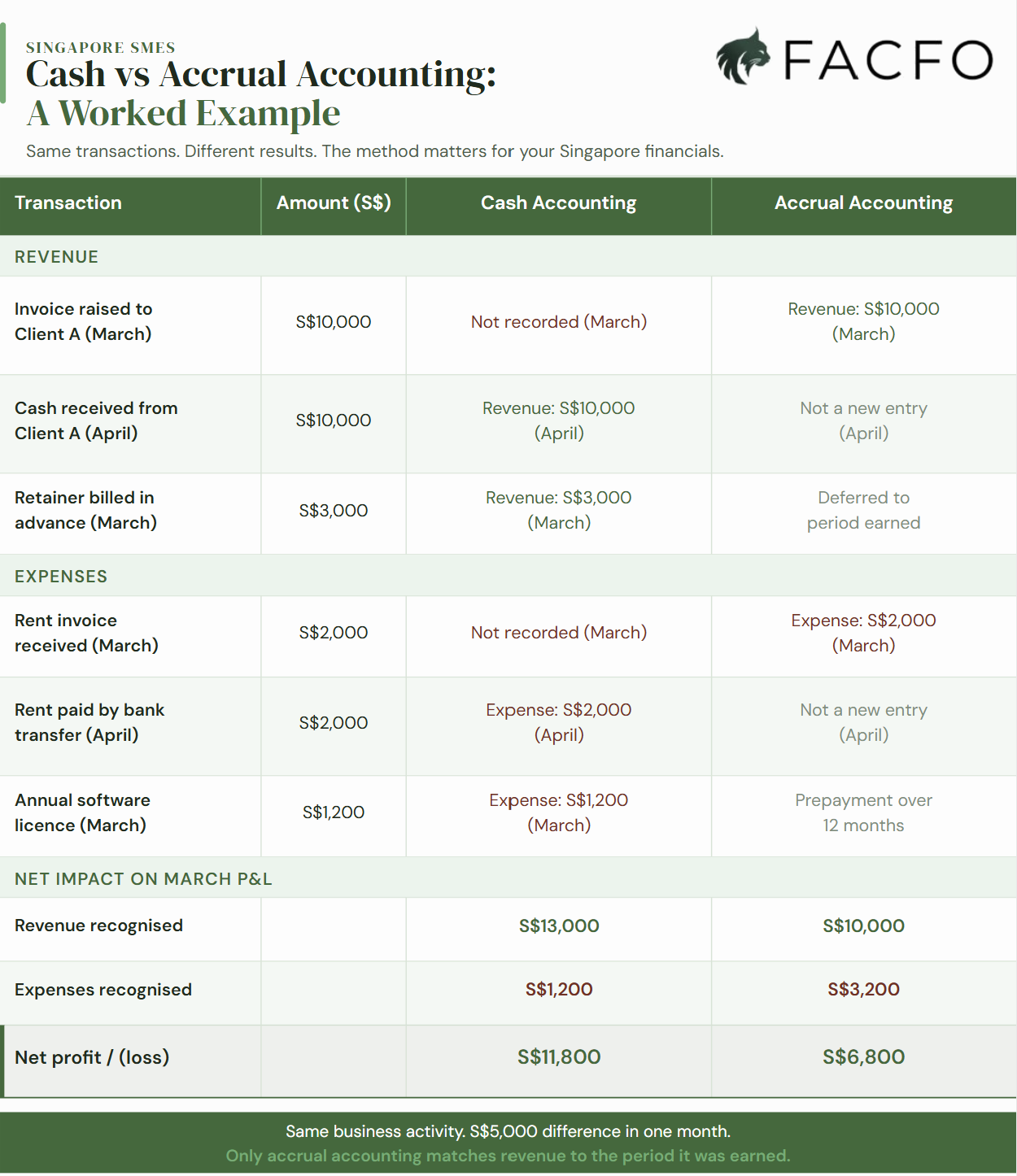
The same business activity produces a March net profit of S$11,800 under cash accounting and S$6,800 under accrual accounting, a difference of S$5,000 in a single month. Neither figure is wrong in isolation, but only the accrual figure accurately matches revenue to the period in which it was earned.
What IRAS and ACRA Require You to Keep
Many business owners assume that keeping their bank statements is sufficient for tax and compliance purposes. It is not.
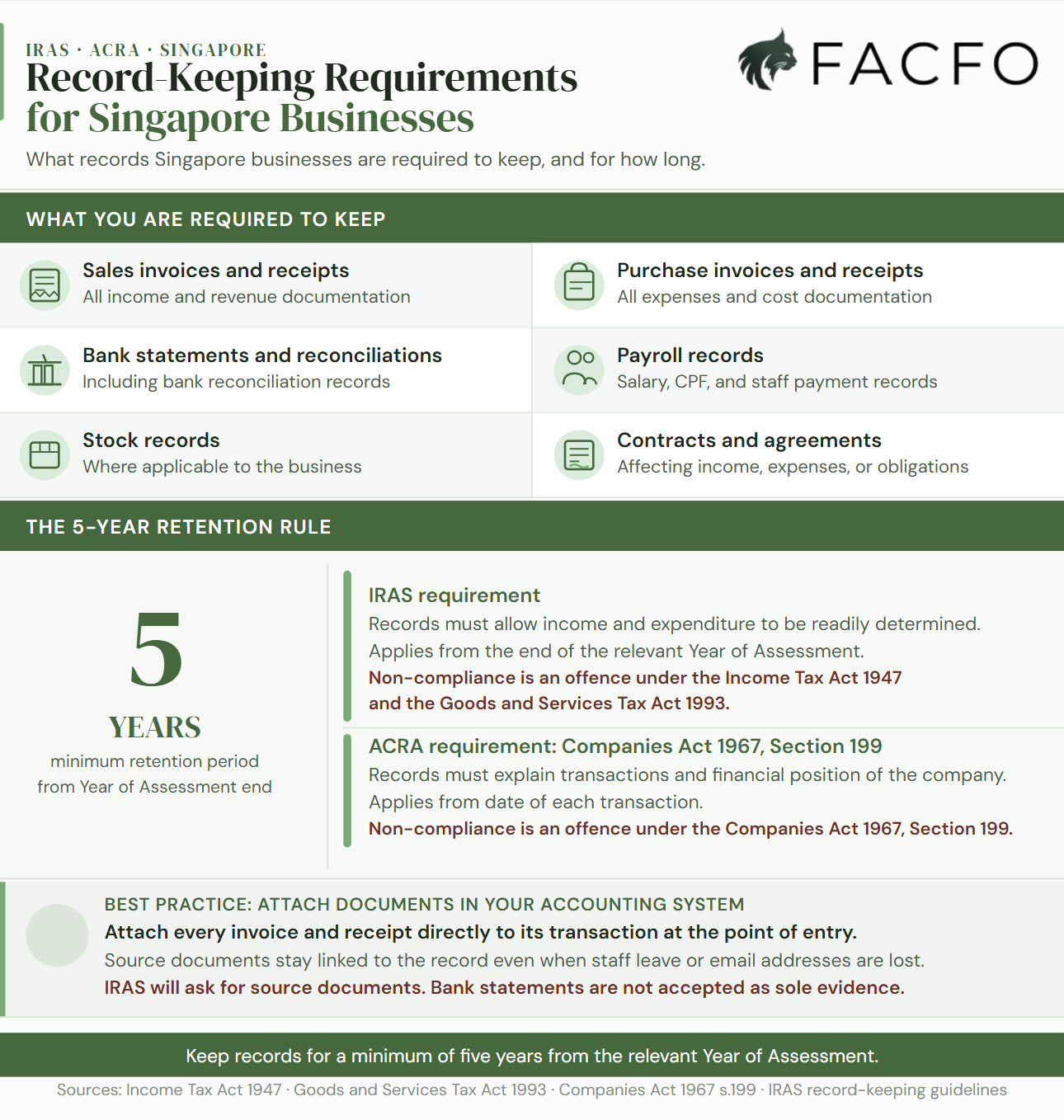
Under the Singapore Income Tax Act, IRAS requires businesses to retain records for a minimum of five years from the end of the relevant Year of Assessment. These records must be sufficient to enable the business’s income and expenditure to be readily determined, and must include supporting documentation beyond bank entries alone.
IRAS specifies that acceptable records include:
- Sales invoices and receipts
- Purchase invoices and receipts
- Bank statements and bank reconciliation records
- Payroll records
- Stock records (where applicable)
- Contracts and agreements that affect income or expenses
ACRA’s requirements under the Companies Act reinforce this. Section 199 of the Companies Act requires every company to keep accounting and other records that sufficiently explain the transactions and financial position of the company. Records must be kept for at least five years from the date of the transaction they relate to. Failure to maintain proper records is an offence under the Act.
Bank statements show that money moved. They do not, by themselves, show what the transaction was for, which account it should be coded to, whether it was a business or personal expense, or what supporting documentation exists. You need both.
A practical recommendation: keep supporting documents attached directly within your accounting system, linked to the transaction they relate to. When invoices and receipts are stored externally, in a shared drive, email inbox, or on a staff member’s personal device, they are far more likely to be lost when that person leaves the business, changes roles, or loses access to the platform. Attaching source documents at the point of entry eliminates that risk entirely.
Why Doing Your Own Bookkeeping Is Usually Not Recommended
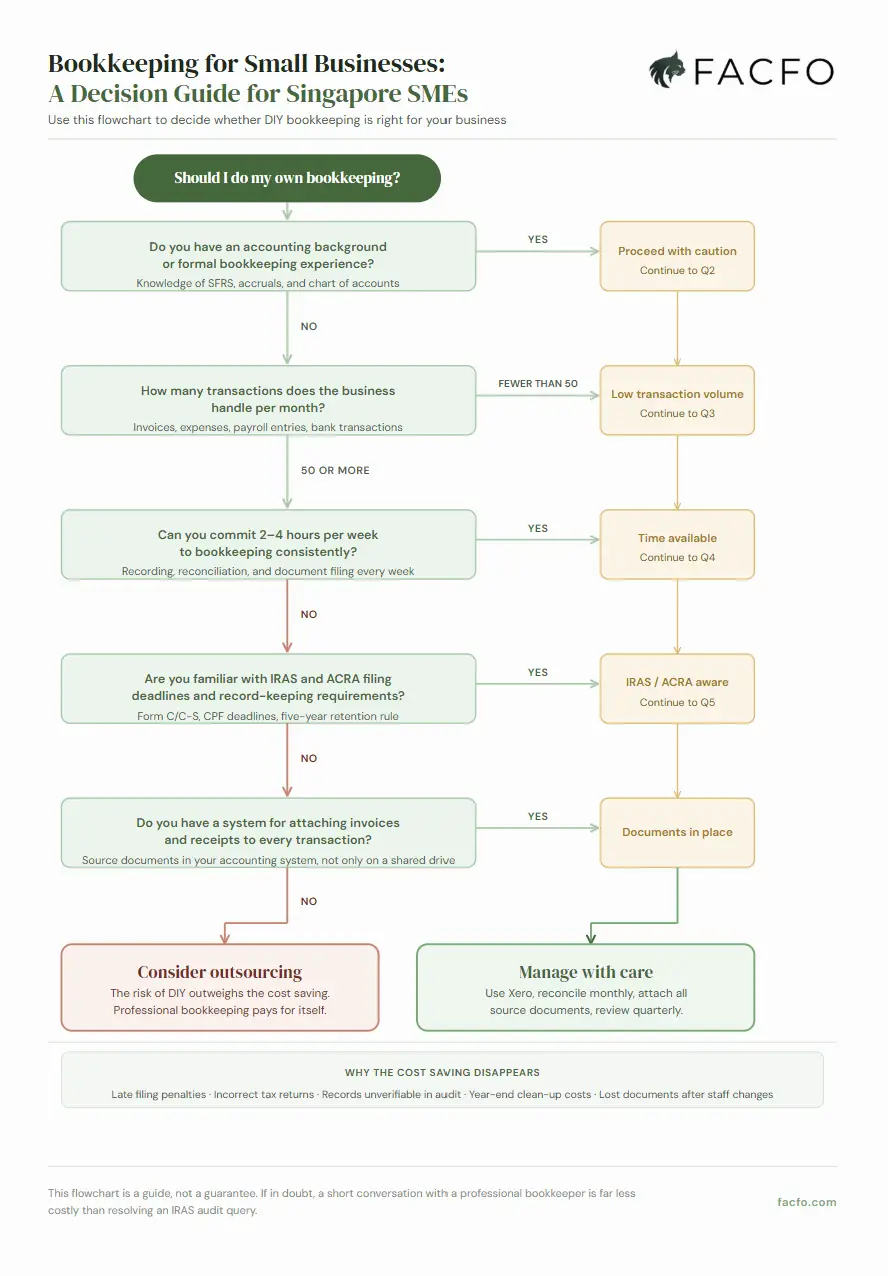
Plenty of small business owners start out managing their own books. It feels like a logical way to keep costs down, especially in the early stages. The problem is that bookkeeping is not simply data entry. Done properly, it requires an understanding of accounting principles, Singapore’s regulatory environment, and the discipline to keep records current throughout the year. Without those three elements, the risk profile rises quickly.
The perceived cost saving from doing it yourself is often smaller than it first appears. Penalties from IRAS for late or incorrect filing can be significant, and the cost of engaging an accountant to reconstruct months of poorly maintained records typically exceeds what professional bookkeeping would have cost in the first place. The savings evaporate quickly once compliance issues enter the picture.
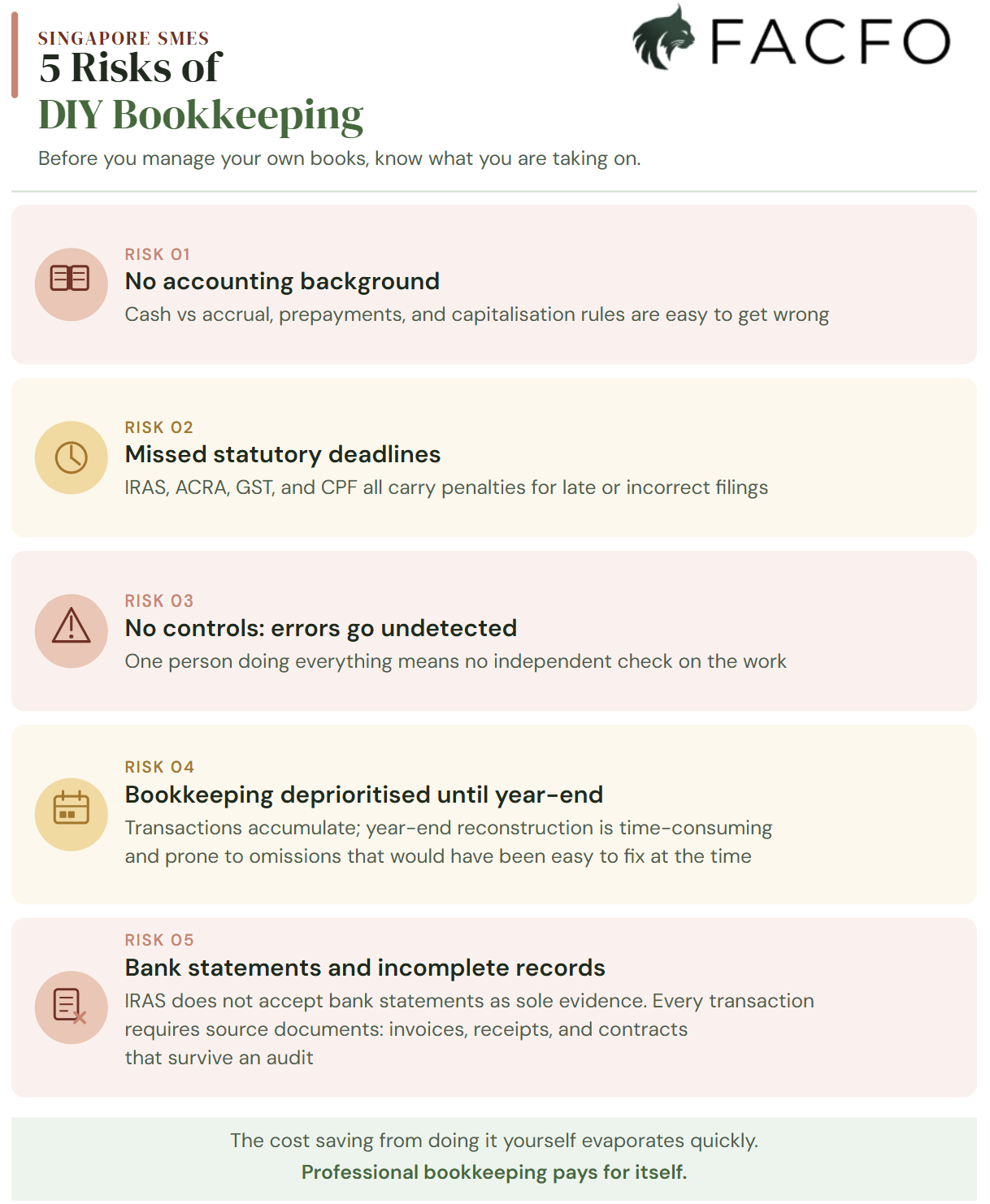
Here are the five most common risks that arise when business owners handle their own bookkeeping without an appropriate background or system. These are not signs of carelessness. In most cases, they are the direct consequence of not knowing what the regulations require.
Insufficient Knowledge of Accounting Standards
Without formal accounting training, most business owners are not familiar with the relevant standards. This includes the difference between cash and accrual accounting, how to treat prepayments and accruals, when to capitalise an asset versus expense it, and how to handle intercompany transactions or related-party dealings. These are not edge cases. They come up regularly in the course of normal business, and recording them incorrectly creates errors that compound over time.
Unawareness of Statutory Deadlines
Singapore businesses face a number of recurring statutory deadlines throughout the year. IRAS requires corporate income tax returns to be filed via Form C or Form C-S by 30 November each year. Companies subject to GST must file quarterly returns, typically within one month of the end of each accounting period. ACRA requires annual returns to be filed within specified timeframes following the end of the financial year. Payroll obligations such as CPF contributions must be made by the 14th of the following month. Missing these deadlines attracts penalties, and in some cases, late filing surcharges that accumulate the longer a submission remains outstanding.
Tracking these deadlines manually across multiple obligations is where things fall through. We have built a free statutory compliance tracker for small businesses that you can download and adapt to your own filing calendar.
Lack of Controls and the Risk of Human Error
When one person is responsible for all aspects of bookkeeping, whether recording transactions, reconciling accounts, or preparing reports, there is no independent check on their work. This is a basic internal control weakness. Errors can go undetected for months. In businesses where the owner is also the bookkeeper, there is also a risk of inadvertently mixing personal and business transactions, which creates complications at tax time and muddies the financial picture for anyone reviewing the accounts.
Bookkeeping Deprioritised Until Year-End
For a business owner, bookkeeping is rarely the most urgent item on the list. Sales calls, client delivery, and operational issues push it to the back of the queue. What happens in practice is that transactions accumulate for weeks or months before anyone records them. By year-end, the business owner is reconstructing months of activity from memory, inboxes, and bank statements.
This creates two compounding problems. First, small errors and omissions that would have been straightforward to fix at the time become far harder to resolve months later. Suppliers may have updated their records. Staff who processed a transaction may have left. Invoices get lost. What starts as a minor discrepancy becomes a reconciliation exercise that takes days rather than hours. Second, deferred bookkeeping means you have had no useful financial data throughout the year, which limits your ability to spot trends, manage cash flow, or make informed decisions.
Bank Statements and Incomplete Records Are Not Sufficient
IRAS does not accept bank statements as the sole record of business transactions. A bank statement confirms that a payment was made or received. It does not explain the nature of the transaction, its tax treatment, or which account it belongs to. During a tax audit, IRAS will ask for source documents. If they cannot be produced, the business is exposed.
Every transaction needs a corresponding document. A payment to a supplier needs an invoice. A receipt from a client needs to be traceable back to a sales order or contract. Expenses claimed against the business need evidence of their business purpose. When documentation is missing, transactions cannot be verified during an audit, and the business may lose the ability to claim legitimate deductions.
If these risks feel familiar, it may be worth exploring what a fractional CFO in Singapore can do beyond bookkeeping: from cash flow modelling to management reporting and strategic financial oversight.
What Good Bookkeeping Looks Like in Practice
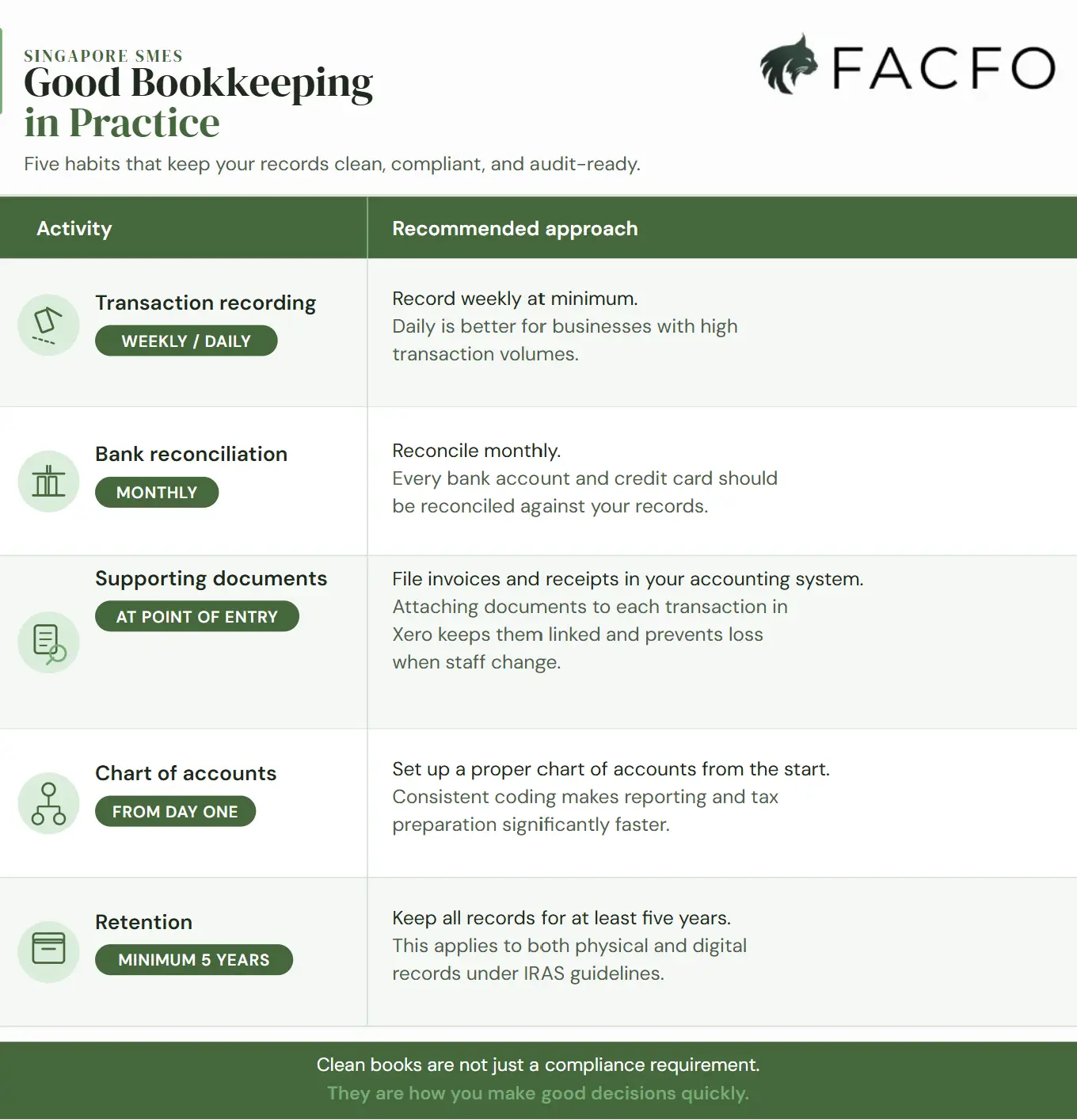
Well-managed bookkeeping is not complex, but it does require consistency. Here is what the basics look like for a Singapore SME:
Choosing the Right Accounting System
For most Singapore SMEs, a cloud-based accounting platform is the practical foundation for good bookkeeping. We work primarily with Xero, which is our system of choice. Xero is well-suited to growing businesses precisely because it scales with you. At the early stage, it handles core bookkeeping effectively. As the business grows, Xero’s app ecosystem allows you to extend the platform with purpose-built integrations, whether for payroll, expense management, inventory, payment processing, or approval workflows. Each extension plugs into the same data set, which means your financial records remain centralised and connected as complexity increases.
For Singapore SMEs already using Xero, our guide to customisable Xero reports covers the key reports worth setting up and how to tailor them to decision-making at different levels of the business.
For businesses at the point where they need more structured approval processes, tools like ApprovalMax integrate directly with Xero to add controlled multi-level authorisation without disrupting the existing workflow. This kind of modular, integrated approach is significantly more scalable than managing everything through spreadsheets or standalone tools that do not talk to each other.
When Should You Consider Getting Help?
There is no single trigger point, but these situations are worth reflecting on:
- You are behind on recording transactions by more than a few weeks
- Your accountant spends significant time each year cleaning up your books before they can prepare your tax return
- You cannot quickly answer “how much cash does the business have right now” or “what is our outstanding debtor balance”
- Your business is growing and the volume of transactions is increasing
- You are approaching statutory deadlines and your records are not current
If any of these apply, it may be worth looking at what bookkeeping services for Singapore businesses can offer. Outsourcing bookkeeping does not mean losing visibility into your finances. Done well, it means gaining more visibility, with the confidence that the underlying records are accurate and compliant.
Getting Your Bookkeeping Right from Day One
Bookkeeping for small businesses is not a back-office formality. It is the foundation of your financial function. Without it, your tax filings rest on incomplete records, your management decisions are based on guesswork, and your exposure to IRAS or ACRA queries is higher than it needs to be.
The five risks covered in this article are not the result of negligence. They are the natural consequence of operating in an area where the regulatory requirements are specific, and where most founders have had no reason to learn them in detail. Under Singapore law, the consequences of non-compliance do not distinguish between deliberate avoidance and honest unawareness.
Getting the foundations right, with proper records, the correct accounting method, supporting documentation stored in your accounting system, and a scalable platform beneath it, is significantly less expensive than fixing the problems that accumulate when those foundations are missing.
If you want to understand the full scope of what management accounting and financial reporting can look like beyond basic bookkeeping, our services page sets that out clearly.