
Most Singapore SMEs reach a point where the founder can no longer hold the finances together alone, yet the business cannot quite justify a senior full-time hire. That is usually the moment the fractional CFO vs full-time CFO question surfaces. You need sharper financial direction: better forecasting, tighter cash management, and a credible story for investors or the bank. The decision is not only about cost. It is about how much senior finance leadership your business needs right now, how that need will change, and how you want to pay for it. This guide compares the two models on scope, cost, and commitment in a Singapore context, sets out when each makes sense, and explains a third path for founders who need serious financial guidance before they can fund it in full. You will also get the actual Singapore cost maths, and a straight answer on whether you can pay a fractional CFO partly in equity and how that is taxed.
Fractional CFO vs full-time CFO: what is the difference?
A full-time CFO is a permanent senior hire who runs your entire finance function. A fractional CFO is an experienced finance leader who does the same strategic work on a part-time, ongoing basis, usually one to three days a week, for a fraction of the cost. The difference is one of dosage and commitment, not seniority.
Both bring board-level judgement to forecasting, cash strategy, fundraising, and financial controls. The fractional model simply gives you that judgement in the proportion your business actually uses. The role itself is covered in depth in our explainer on what a fractional CFO is, so this article stays focused on how it compares with a full-time hire.
Is a fractional CFO just a consultant or an accountant?
No, and the distinction matters for this decision. A consultant hands you a report and leaves; an accountant records what has already happened. A fractional CFO is embedded in the business, sitting in leadership and board meetings, owning the forecast and the cash flow, and answering for outcomes rather than recommendations. That ongoing accountability, not one-off advice, is what you are weighing against a full-time hire.
In a Singapore context the role also means keeping reporting aligned with the Singapore Financial Reporting Standards, managing auditors, staying ahead of ACRA and IRAS obligations, and getting the numbers investor-ready or lender-ready. The practitioner side of this model is described well in our wider writing on what fractional leadership involves.
How much does each option cost in Singapore?
A full-time CFO commands a substantial package. Recruitment salary guides place average CFO pay in Singapore broadly in the region of S$200,000 to S$385,000 a year, before bonus, employer CPF, and benefits, according to the Robert Half 2026 Singapore Salary Guide and similar surveys. For a genuine senior hire, the all-in annual cost can comfortably exceed S$300,000.
What does a S$200,000 CFO actually cost?
More than S$200,000. Because employer CPF is capped, the salary itself attracts only about S$17,340 in CPF, but a bonus and benefits lift the total. A S$200,000 base typically costs around S$240,000 to S$285,000 a year once CPF, the Skills Development Levy, a bonus, and benefits are added.
- Employer CPF: From 1 January 2026 it applies only to the first S$8,000 of monthly wages and to S$102,000 of total annual wages, so the most a S$200,000 salary attracts is 17 percent of S$102,000, about S$17,340.
- Skills Development Levy: about S$135 a year.
- Bonus: commonly one to three months, roughly S$17,000 to S$50,000.
- Benefits: medical, insurance, and similar, illustratively S$5,000 to S$15,000.
A full-time hire also accrues paid annual leave, a statutory floor of seven days rising to 14 with service and usually more by contract for a senior role, which you fund and must cover when they are away, with any unused balance paid out on exit. If the hire is a foreigner on an Employment Pass, no CPF applies, though a bonus, benefits, and leave still do. A fractional CFO carries none of these on-costs: you pay only for the days delivered.
A fractional CFO is usually engaged on a monthly retainer for an agreed number of days. As an illustration, that might run from around S$3,000 to S$12,000 or more a month depending on days and seniority, which is materially less than a full-time package, with no CPF, bonus, or severance commitment. These figures are indicative and will vary with sector, scope, and the experience you need, so treat them as a starting point rather than a quote.
Fractional CFO vs full-time CFO at a glance
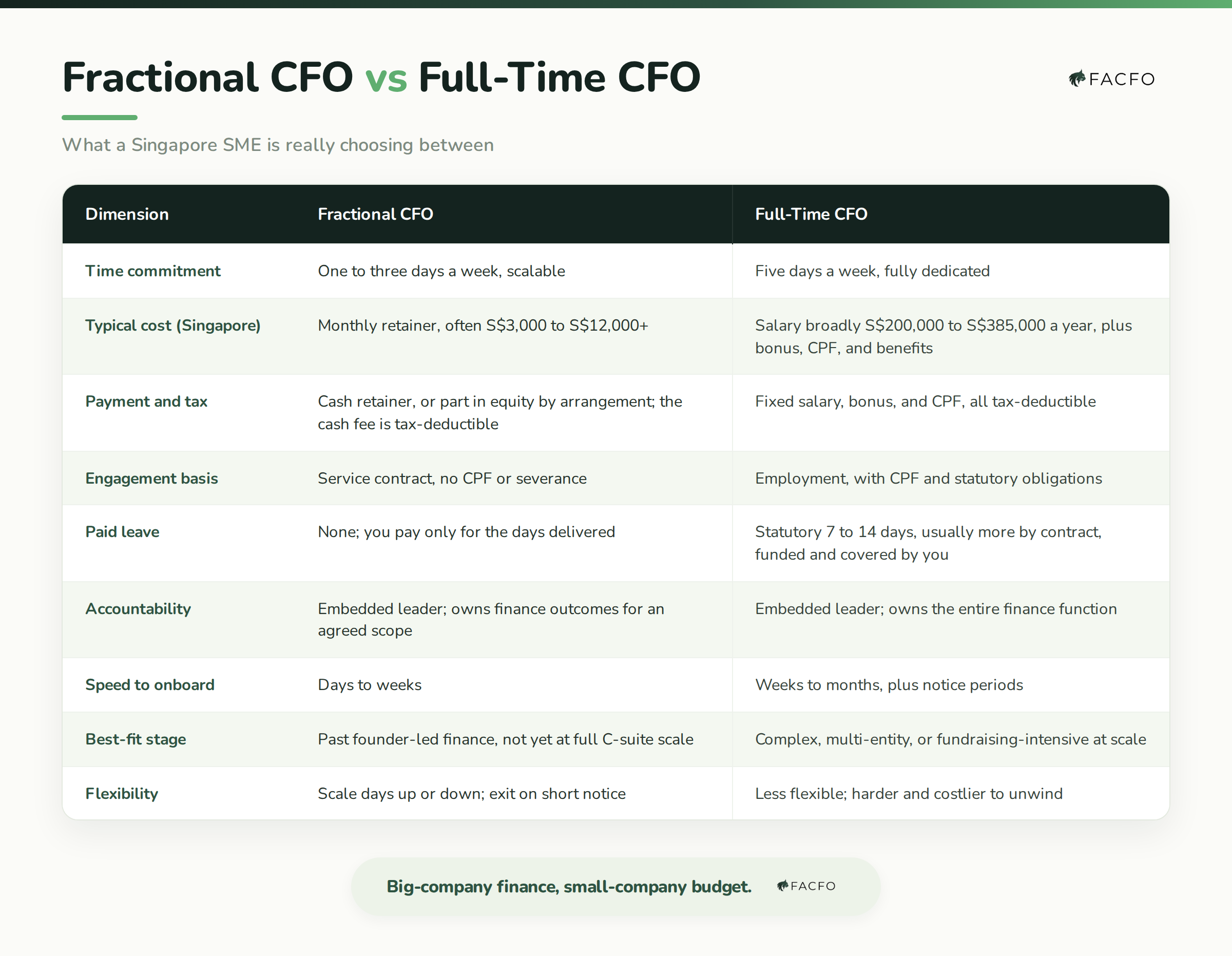
Read across the rows and a pattern emerges. The full-time model gives you depth and constant presence. The fractional model gives you the same seniority with flexibility and a far lower fixed cost. Which one wins depends entirely on how heavy and how constant your finance needs are.
When does a Singapore SME need a full-time CFO instead?
A full-time CFO earns the higher cost when finance is complex and daily rather than periodic. That tends to mean several of the following are true: you run multiple entities or jurisdictions, you raise capital frequently, you operate in a regulated sector, you are on an IPO or private-equity track, or you have a finance team large enough to need full-time management.
A full-time hire also makes sense when you need someone physically present and fully dedicated, owning relationships and decisions across every working day, and when the role naturally spreads beyond finance into operations and strategy. If that describes your business, the salary is an investment rather than an overhead. For most SMEs that have simply outgrown founder-led finance, though, that level of constant presence is more than the business uses.
What if you need CFO guidance but cannot fund it yet?
There is a school of thought that a cash constraint should not lock a founder out of senior financial guidance. If the need is real but the cash is not there yet, the engagement can be structured so the monetary outflow is lower and part of the reward is tied to the value created. Several structures do this:
- Reduced cash retainer plus advisory equity. A lower monthly fee, topped up with a small, vesting equity grant.
- Equity-weighted or equity-only. More of the reward shifts to ownership, suited to earlier or pre-revenue businesses, and carrying more risk for the adviser.
- Success or milestone fees. A fee triggered by a defined outcome, such as closing a funding round or securing a bank facility.
- Deferred fees. Part of the fee is paid later, tied to an agreed cash-flow event.
- A blend of a modest retainer, some equity, and a milestone fee, balancing cash, ownership, and alignment.
What advisor equity typically looks like in Singapore
Where founders take the equity route, the arrangement usually has a recognisable shape:
- A small grant of ordinary shares with vesting, or share options under an advisor or ESOP-style scheme, governed by a written advisor agreement.
- Advisory equity is usually modest. Pure advisers often sit in the 0.1% to 1.0% range. Where a fractional CFO takes equity in place of a meaningful share of cash, the figure is negotiated higher to reflect the cash forgone and the seniority involved.
- The equity typically vests monthly or quarterly over one to two years, often with a short cliff of three to six months, so it is earned over the engagement rather than granted up front.
- Issuing shares needs board and shareholder approval, and a Return of Allotment lodged with ACRA within 14 days. Options require a documented scheme.
- Tax for the company. A cash fee is normally deductible as an expense incurred in earning income. Paying in newly issued shares is not a cash outgoing, so it does not give the company any tax deduction on the portion paid by shares. In short, the equity route can save cash while forfeiting the deduction a cash fee would have attracted.
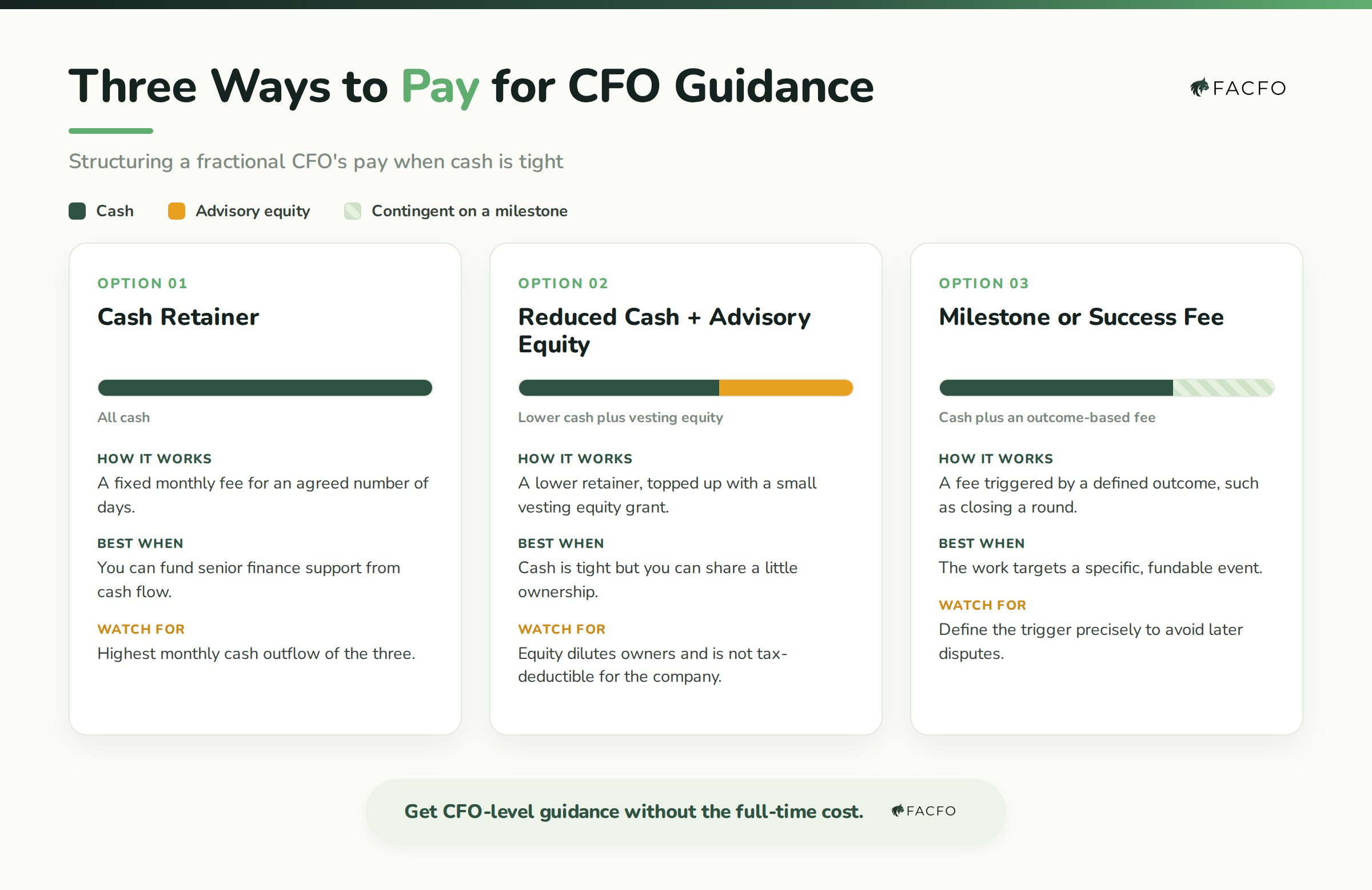
Be clear-eyed about the trade-offs. Equity dilutes existing owners and may ultimately be worth nothing. Tying part of an adviser’s reward to outcomes aligns incentives, but it can also affect how independent that adviser’s judgement looks, which matters for a finance role. And it adds governance and administrative work. The right blend depends on your stage, your cash position, and your appetite for sharing ownership.
How to decide which model fits your business
A short set of questions usually settles it. Work through them honestly:
- How many days of senior finance leadership do you genuinely need each month?
- Is the need ongoing, or tied to a specific event such as a raise, a turnaround, or a systems build?
- Can you fund a full-time package without starving other priorities?
- Do you need someone embedded full-time, or is focused senior input enough?
- Would aligning part of the cost to equity or to a milestone suit your cash position?
As a rule of thumb, businesses that have moved past founder-only finance but are not yet at full C-suite scale tend to be well served by a fractional arrangement, and many use it to build the finance function to the point where a full-time hire is finally justified.
The bottom line
The choice between a fractional CFO and a full-time CFO comes down to dosage, cost, and commitment. A full-time CFO suits businesses whose finance needs are complex, constant, and worth a full salary. A fractional CFO gives most growing SMEs the same senior judgement in the proportion they use, at a fraction of the fixed cost, and equity-based or milestone structures can bridge the gap when cash is tight.