

You have decided that Singapore is where your next business chapter begins. It is a sound choice. Singapore incorporation for foreign entrepreneurs offers a stable legal framework, a respected regulatory environment, and a tax regime that genuinely rewards substance. But the system is more nuanced than the headline 17% rate suggests, and a number of foreign founders find this out the hard way.
Common pitfalls include picking the wrong structure, treating the resident director rule as the entire compliance answer, and assuming that a Singapore-registered company is automatically a Singapore tax resident.
Consider this guide the conversation we wish more founders had with us before they incorporate a company in Singapore, not after. We will cover structure, the resident director question, what tax residency actually requires, what residency unlocks.
Singapore Business Structures: Your Options as a Foreign Entrepreneur
Singapore offers a small, well-defined set of legal structures. Most foreign entrepreneurs only need to seriously consider one, but knowing the alternatives helps you understand why.
A Private Limited Company (Pte Ltd) is the standard choice. It is a separate legal entity, offers limited liability, can be 100% foreign-owned in most sectors, and is taxed at the standard 17% corporate rate. The effective rate often comes in lower.
A Branch Office is an extension of a foreign parent company, not a separate legal entity. The parent carries full liability for what the branch does, and the branch is taxed as a non-resident, which closes off most local tax incentives.
A Representative Office is a temporary arrangement for market exploration. It cannot generate revenue, sign contracts, or perform commercial activities. Useful as a first toe in the water, not a long-term structure.
A Sole Proprietorship is generally not available to foreigners without local residency status, and offers no liability protection.
A Limited Liability Partnership (LLP) is a niche choice, used mostly by professional services firms. It is rarely the right answer for an operating business with growth plans.
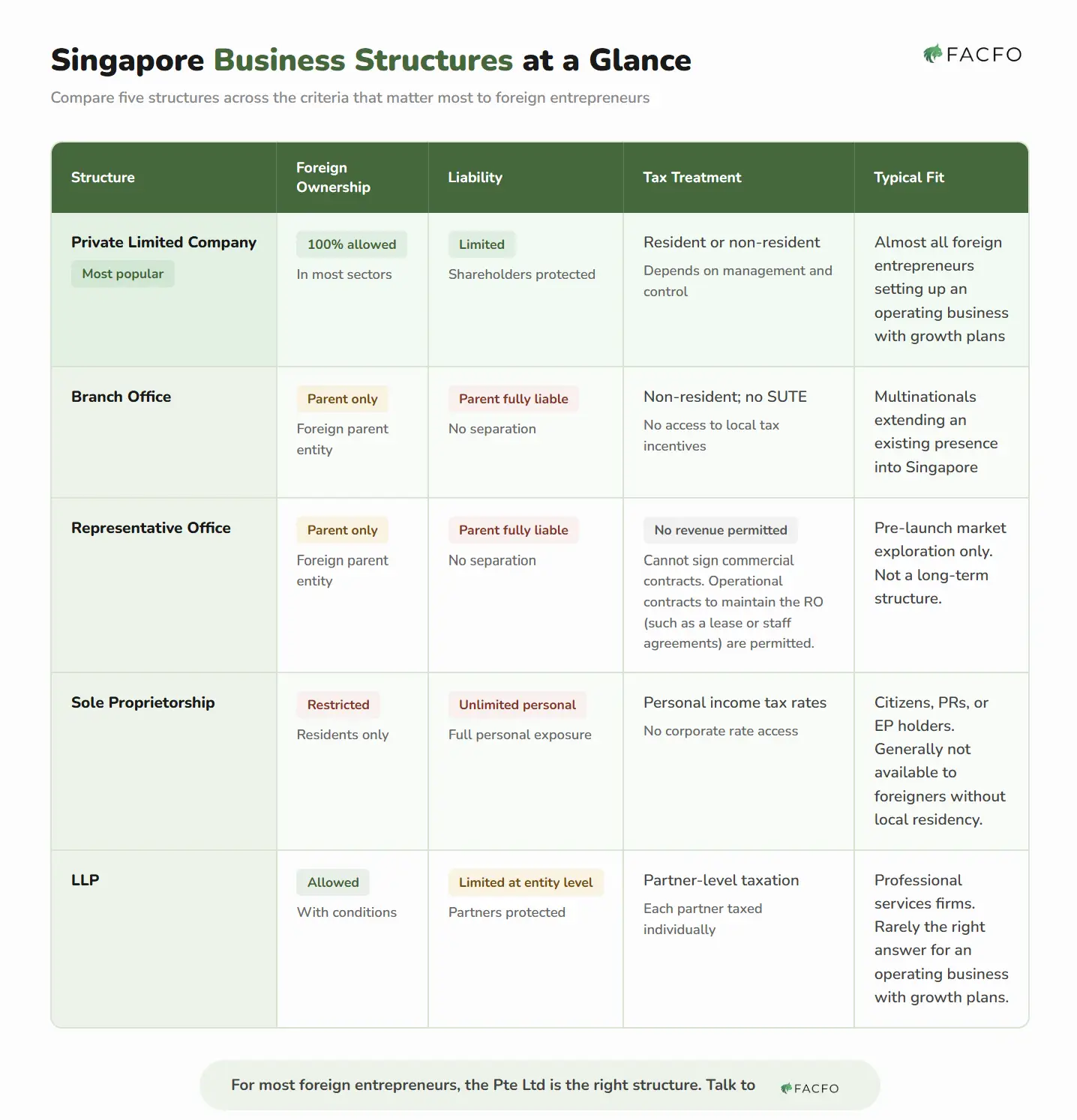
For most foreign entrepreneurs setting up an operating business with growth plans, the Pte Ltd is the right structure. It can issue shares, take on investors, accommodate later restructurings, and qualifies for the Singapore tax incentives that make incorporation here worthwhile in the first place. The remaining sections of this guide therefore focus on the Pte Ltd.
The Resident Director Requirement and the Nominee Arrangement
Every Singapore company must have at least one director who is ordinarily resident in Singapore. This is Section 145 of the Companies Act 1967. In practice, ordinarily resident means a Singapore Citizen, a Permanent Resident, or the holder of an Employment Pass, EntrePass, or Dependant Pass with Letter of Consent who maintains a local residential address. The requirement applies from the day of incorporation. ACRA’s guidance on setting up a local company sets out the formal position.
Many foreign entrepreneurs solve this through a nominee director arrangement: a local resident appointed via a Corporate Service Provider to satisfy the requirement on paper. This is legitimate and widely used. The Corporate Service Providers Act, in force since June 2025, has put nominee arrangements on a regulated footing. Appointments now go through registered CSPs, with mandatory fit-and-proper assessments and public disclosure of nominee status. Used carefully, nominee directors are a sensible part of the toolkit, particularly while you arrange your own EntrePass or Employment Pass.
What a nominee director cannot do, on its own, is deliver tax residency for your company. The two requirements look similar from the outside, but they are tested by different regulators against different standards. ACRA looks at whether someone resident in Singapore is on the board. IRAS looks at where decisions are actually made. We will come back to this in the management and control section.
If you plan to use a nominee, plan it as a stop-gap or as one part of a broader substance arrangement, not as a complete answer. Companies that incorporate, install a nominee, and then run everything from abroad are the ones most likely to discover months later that they have a residency problem they did not know they had.
A stronger alternative, where this is an option for you, is to bring on a genuine local business partner. A partner who takes an active executive role and participates in board decisions does considerably more than fill the resident director slot. They provide the kind of evidence of management and control in Singapore that IRAS looks for, which a nominee acting purely in a compliance capacity cannot. The arrangement also opens access to government grants and incentives calibrated for businesses with meaningful local presence, which nominee-only structures typically cannot reach.
Tax Residency: Same Rate, Materially Different Outcomes
A Singapore Pte Ltd is taxed at 17% on its Singapore-sourced income whether it is a tax resident or not. IRAS itself describes resident and non-resident companies as generally taxed in the same manner. So far, so similar.
In practice though, residency is the gateway to a substantial benefits package. Same rate, materially different outcomes:
- Access to Singapore’s network of approximately 100 Double Taxation Agreements. Resident companies can use these to reduce foreign withholding tax on inbound royalties, interest, and dividends. Non-residents cannot.
- The Section 13(8) exemption on foreign-sourced dividends, foreign branch profits, and foreign-sourced service income remitted into Singapore (subject to conditions). Residents only.
- Foreign Tax Credit, Unilateral Tax Credit, and FTC Pooling, which provide relief for foreign tax suffered on the same income. Residents only.
- The Start-Up Tax Exemption. Residents only, and only in the first three Years of Assessment.
- Group Relief, which lets you transfer current-year losses between Singapore group companies. Residents and Singapore-incorporated only.
- The Certificate of Residence, which banks, customers, and tax authorities increasingly request as proof of treaty entitlement. Residents only.
- Most other tax incentives. Residents only.
For a Pte Ltd with foreign owners, foreign customers, or cross-border payments, tax residency is not a technical formality. Singapore’s network of Double Tax Agreements (DTAs) allows a Singapore tax resident company to access reduced withholding tax rates on dividends, interest, and royalties received from treaty partners. Separately, the Section 13(8) exemption can shelter qualifying foreign-sourced income from Singapore corporate tax entirely. A non-resident company is excluded from both. Depending on the volume of cross-border flows, the combined effect can shift your effective tax cost by several percentage points.
Over three qualifying Years of Assessment, the Start-Up Tax Exemption can shelter up to S$375,000 of chargeable income, a total tax saving of up to S$63,750 at the current 17% rate. Relative to the Partial Tax Exemption available to all companies, the incremental benefit is S$11,475 over the same period, modest in isolation, but worth claiming automatically if your company qualifies.
Management and Control: The Tax Residency Test
IRAS determines a Singapore company’s tax residency by where its management and control is exercised. IRAS defines this as the making of decisions on strategic matters, including the company’s policy and strategy. The location of the company’s board meetings, where those strategic decisions are made, is usually the determining factor. The place of incorporation, importantly, is not.
Two points are worth knowing in detail.
First, on board meetings. Physical board meetings held in Singapore, with minutes documenting where directors were located and what was decided, remain the strongest evidence of management and control in Singapore. If your board meets entirely abroad and your minutes record decisions taken outside Singapore, you are working against the grain of the test, and you will need other evidence (such as substantive executive engagement in Singapore) to make your case.
Second, on virtual and hybrid meetings. Following the Companies Act amendments effective July 2023 permitting fully virtual meetings, IRAS issued guidance in December 2023 on how virtual or hybrid meetings are assessed. Such a meeting is treated as having strategic decisions made in Singapore if either at least 50% of the directors with strategic decision-making authority are physically in Singapore during the meeting, or the Chairman of the board is physically in Singapore during the meeting. A purely virtual meeting with all directors abroad does not meet this test. A meeting where only a nominee director is in Singapore typically does not either.
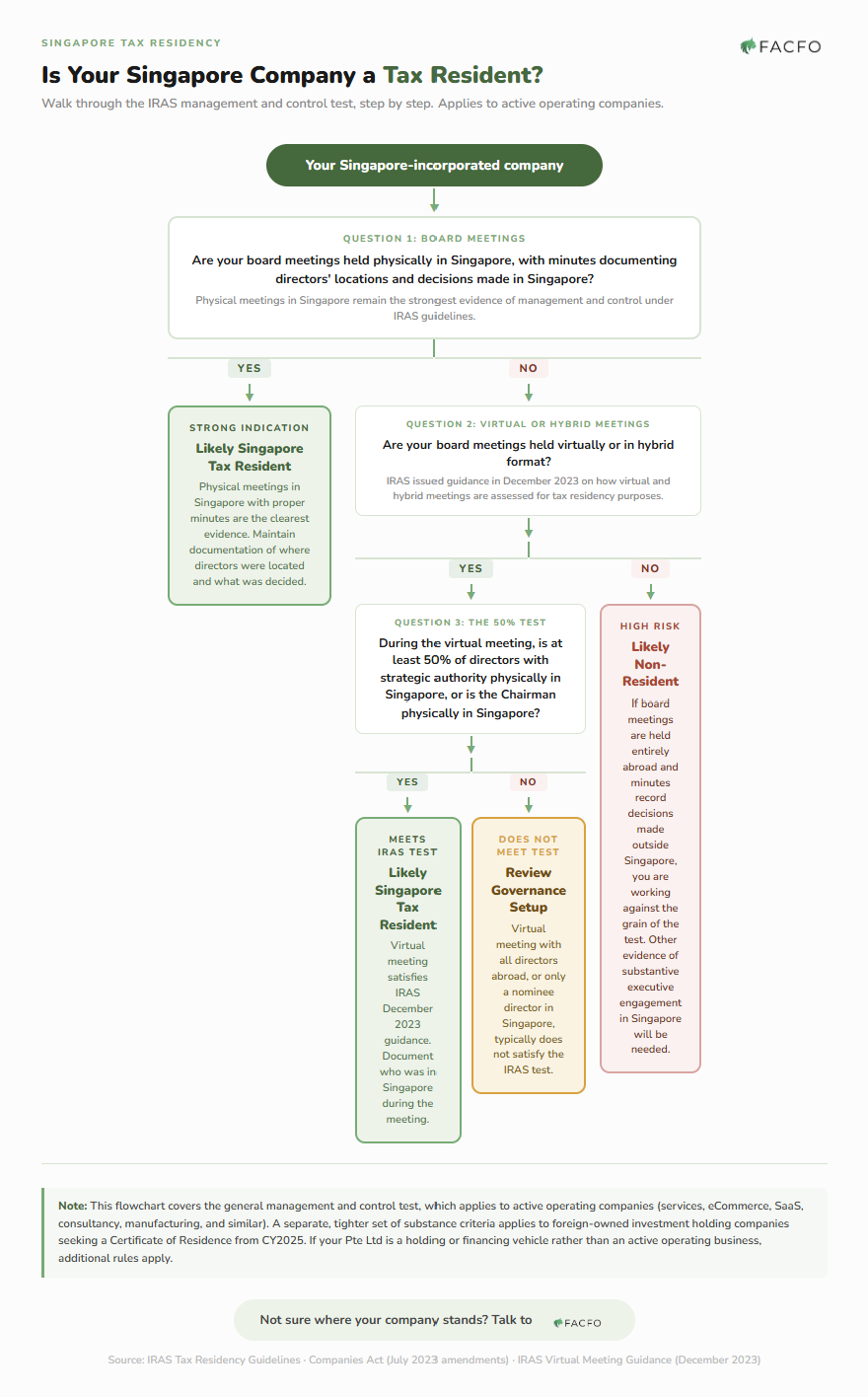
For most foreign entrepreneurs running an active operating business (services, eCommerce, SaaS, consultancy, manufacturing, and so on), this general test is the relevant standard. Substance for an operating company is built primarily through real customers, real revenue, real contracts, and real operations, supplemented by demonstrating that strategic decisions are made in Singapore. There is no separate substance checklist that an active operating Pte Ltd needs to satisfy.
The practical implications for the typical foreign founder are straightforward. Treat the nominee director as part of the answer, not the whole answer. Hold board meetings in Singapore where you can, or use the hybrid format with the 50% directors or Chairman test in mind. Document the strategic decisions and where they were made. Where the operating reality involves decision-makers based abroad, structure your governance so that an executive director or key employee is genuinely engaged in Singapore. The cleanest path, where it is feasible, is to obtain your own EntrePass or Employment Pass and serve as a substantive director yourself.
Two honest caveats. There is no published Singapore court ruling directly on whether a nominee director defeats corporate tax residency. And IRAS has not issued specific guidance for digital or remote businesses. The substance analysis rests on the management and control test and the December 2023 virtual-meeting framework. For high-value cross-border setups, planning around both from the start is materially cheaper than retrofitting later.
Getting the structure and substance right from day one is significantly easier than retrofitting it later. Our team works with foreign founders at every stage of this process: from incorporation through to ongoing financial management. If you are evaluating what financial leadership looks like once you are set up, our guide to fractional CFO services in Singapore is a useful starting point.
A Note for Foreign-Owned Investment Holding Companies
If your Singapore Pte Ltd is set up as a holding or financing vehicle rather than an active operating business, typically a foreign-owned company whose income is mainly passive (dividends, interest, royalties, capital gains) rather than from active trading, a tighter set of rules applies when you seek a Certificate of Residence.
From calendar year 2025, IRAS requires foreign-owned investment holding companies to satisfy at least one of the following, in addition to passing the management and control test:
- A related Singapore resident or operating company exists within the same corporate group.
- The company receives administrative support from a Singapore-related company within the same group (not from an unrelated third-party service provider).
- At least one Singapore-based director holds an executive position and is not a nominee director.
- At least one Singapore-based key employee, such as the CEO, CFO, or COO, is in place.
The phrase “is not a nominee director” is IRAS’s own language. The first two criteria are typically satisfied by multinational groups with existing Singapore operations. The third and fourth are the practical paths for a standalone foreign-owned holding company. If you are setting up a holding or treasury vehicle, plan one of these from the start. If you are setting up an active operating business, this section does not apply to you.
Compliance and Pre-Incorporation Essentials
Beyond the structure and residency, every Singapore Pte Ltd carries a defined set of statutory requirements. These are not optional, and falling behind on any of them carries penalties.
You will need:
- A registered office address in Singapore.
- A company secretary, appointed within six months of incorporation. The secretary must be a natural person ordinarily resident in Singapore. Many foreign founders outsource this through corporate secretary services from the start, which keeps annual filings on track without distracting from the operating business.
- At least one shareholder, which can be the same person as the director, and can be a foreign individual or entity.
- Annual filings: an Annual Return to ACRA, a corporate income tax return (Form C, C-S, or C-S Lite) to IRAS, and Estimated Chargeable Income within three months of your financial year-end. This requires proper financial records. Our guide to bookkeeping requirements for Singapore SMEs covers exactly what IRAS and ACRA expect you to maintain and for how long.
- An auditor, unless your company qualifies as a small company under the Companies Act and is therefore exempt. A company qualifies as a small company if it is a private company and satisfies at least two of the following three criteria for the immediate past two consecutive financial years: annual revenue of S$10 million or below; total assets of S$10 million or below; and 50 or fewer employees.
- GST registration if your taxable turnover exceeds the prevailing threshold, currently S$1 million.
You will also need a corporate bank account, which has become noticeably harder to open in recent years for foreign-controlled entities. Plan for a longer onboarding window than you might expect, and prepare clean documentation on beneficial ownership and source of funds in advance. Some banks also require a minimum balance to be maintained at all times. That balance is effectively frozen capital: it sits in the account, satisfies the bank’s requirement, and is unavailable for working capital purposes. Factor this into your early cash flow planning before you finalise which institution to approach.
Staying on top of ACRA and IRAS deadlines once incorporated is a discipline in itself. Our statutory compliance tracker for small businesses gives you a ready-made framework you can adapt to your company’s specific filing calendar.
A practical pre-incorporation checklist
Before you file with ACRA, work through the following:
- Confirm the Pte Ltd is genuinely the right structure for your situation.
- Decide who will serve as your resident director, and how this will work in practice. Nominee, your own EntrePass or EP, or a substantive local hire.
- Plan how management and control will be exercised in Singapore in practice, not just on paper. Where will board meetings be held? Who will the substantive resident director be, beyond the nominee?
- Identify your registered office address and your company secretary.
- Set your initial paid-up capital at a level that suits your operating needs and your bank’s expectations. The legal floor is S$1, but most banks expect more.
- Choose your accounting software early and configure it correctly. Migrating later is more expensive than setting up properly upfront.
Getting Singapore Incorporation Right
Singapore incorporation for foreign entrepreneurs is well-supported, well-documented, and well within reach. The mistakes we see come not from the country’s complexity, but from founders treating incorporation as a single transaction rather than the start of an ongoing relationship with the regulatory environment.
The structure choice, the resident director question, and the management and control test are not independent decisions. Each one affects the others, and all three need to be right from the start. A nominee director addresses the residency requirement. A credible management and control plan addresses the tax residency question. Together, they determine whether your Singapore structure delivers what it promises or creates a compliance problem you will spend years unwinding.
If any of this raises questions about your own situation, the answer is usually a short conversation, not a long project.