You can be profitable on paper and still be unable to pay your suppliers next week. For many new business owners, that is not a hypothetical: it is the moment they realise that profit and operating cash flow are not the same thing, and that one of them is far more urgent than the other.This guide explains what operating cash flow is, why it deserves more of your attention than your bottom line, and what you can do right now to stay on top of it.

What Is Operating Cash Flow?
Operating cash flow (OCF) is the cash your business actually generates from its day-to-day operations. It is calculated by taking your net income, adding back non-cash charges such as
depreciation and amortisation, and then adjusting for changes in working capital: things like movements in your receivables, payables, and inventory.A simple way to think about it: profit tells you whether your business model is working. Operating cash flow tells you whether your business can survive the next 30, 60, or 90 days. Beyond day-to-day survival, a healthy OCF position also gives you the capacity to invest in capital expenditure, service debt, and generate free cash flow, the foundation for growth that is funded by the business itself rather than by external financing.The two figures diverge more than most people expect. Revenue recognised under accrual accounting, inventory purchased in advance, slow-paying customers, and capital expenditures can all create a meaningful gap between what appears on your income statement and what actually sits in your bank account.
Profit vs Operating Cash Flow: What Is the Difference?
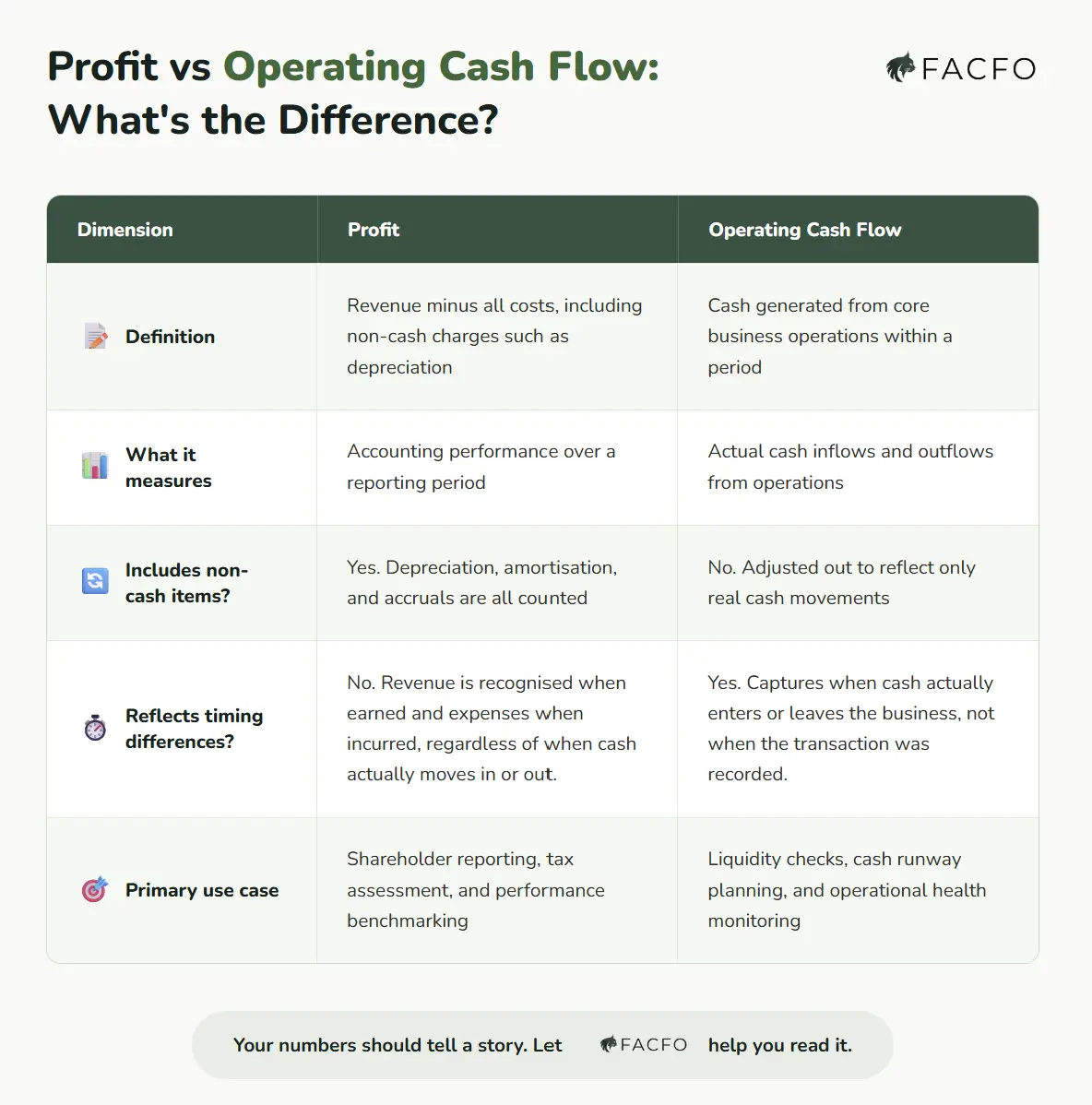
Profit, or net income, is calculated by subtracting all expenses from total revenue. It is an accounting measure. It includes non-cash items, accounts for revenue that has been earned but not yet received, and reflects expenses that have been incurred but not yet paid.Operating cash flow, by contrast, is a cash measure. It strips away timing differences and non-cash entries to show what your business actually collected and spent during a period.The table below illustrates the key differences at a glance.

Consider a straightforward example. Your business invoices a client for £50,000 in December. Your income statement records £50,000 in revenue. But if that client pays in February, your December operating cash flow reflects nothing. The profit is on paper. The cash is not in your account.This timing gap is where businesses get into trouble.
Why New Business Owners Often Get This Wrong
Early-stage businesses are particularly exposed to cash flow pressure for a few interconnected reasons.Customers often take 30 to 90 days to pay, while suppliers expect payment sooner. Stock needs to be purchased before a sale is made. Upfront costs, from equipment to deposits to hiring, hit the bank account long before any returns materialise. And growth, counterintuitively, often makes cash flow worse before it gets better: more orders means more inventory and more labour, all of which need to be funded before the revenue arrives.It is also worth noting that a loss on paper is not always a cause for concern. During periods of deliberate investment, such as new product lines, capacity expansion, or market entry, short-term losses can be entirely intentional and appropriate. What matters during those phases is that your operating cash flow remains manageable. A business can absorb paper losses for longer than it can absorb a cash shortfall.Focusing purely on profit during this period gives you an incomplete, and sometimes dangerously optimistic, picture of where your business stands. For a deeper understanding of how cash flow statements are constructed, the
Corporate Finance Institute’s guide to operating cash flow is a useful reference point.
How Financial Projections Help You Stay Ahead
One of the most effective tools for managing operating cash flow is a well-built
financial projection. Rather than reacting to a shortfall once it has already arrived, a projection lets you see it coming, giving you time to act.A proper cash flow model maps out your expected inflows and outflows on a monthly basis, accounts for payment timing, flags periods where your cash position may dip below a safe threshold, and provides the basis for conversations with lenders or investors if additional funding is needed.The same payment-timing logic underpins your runway: how long the business can keep operating on the cash it has. We cover this in detail in
what burn rate and runway really tell you about your business, including why net operating cash flow is a more reliable basis for the calculation than the simplified burn rate formula.The quality of that model matters enormously. Projections built on rough assumptions, or without a solid understanding of how the income statement, balance sheet, and cash flow statement interact, can give you false confidence. A conservative, well-structured model is worth considerably more than a spreadsheet that simply tells you what you want to hear.This is one of the reasons many founders and early-stage business owners choose to work with
fractional CFO services or
management accounting support rather than building projections entirely on their own. The cost of a material error in a cash flow model can far exceed the cost of getting it right the first time.
Six Practical Steps to Improve Your Operating Cash Flow
You do not need to overhaul your entire business to improve your cash position. A few targeted changes can make a meaningful difference.
1. Invoice promptly and follow up consistentlyThe sooner you invoice, the sooner the clock starts on payment terms. Many businesses leave days or weeks of cash on the table simply by delaying their invoicing cycle. For businesses that already have a collections gap, customers consistently paying late, our guide on
managing late fees and overdue invoices covers both the legal framework and the automation tools that enforce it without straining client relationships.
2. Shorten your payment terms where you canOffering a small early-payment discount (for example, 2% if paid within 10 days) can accelerate inflows significantly.
3. Negotiate payment terms with suppliersIf your customers pay you in 60 days but you pay suppliers in 30, you are effectively funding the gap yourself. Extending supplier terms or aligning them more closely with your receivables cycle reduces that burden.
4. Tighten your inventory managementExcess stock ties up cash without generating returns. A tighter inventory management process frees up working capital that would otherwise sit on a shelf.
5. Build a cash reserve or arrange a credit facilityUnexpected costs are not a question of if but when. Having access to a liquidity buffer, whether a cash reserve or an undrawn line of credit, gives you room to absorb shocks without disrupting operations.
6. Review your cash flow monthly, at minimumA cash flow statement reviewed quarterly is not a cash flow management tool. You need to know your position frequently enough to act on it. Monthly reviews, with a rolling 90-day projection, are the minimum standard for any growing business.
Common Mistakes That Drain Operating Cash Flow
A few patterns come up repeatedly when businesses find themselves in cash flow difficulty.
Overestimating revenue is the most common. Founders are, by nature, optimistic, and that optimism tends to find its way into financial projections. When actuals come in below forecast, the cash shortfall can arrive faster than anticipated. The
Harvard Business Review’s research on working capital consistently points to revenue overestimation as a leading cause of early-stage business difficulty.
Underestimating expenses is equally damaging. It is easy to model the costs you can see and overlook the ones you cannot: compliance fees, insurance renewals, software subscriptions, staff turnover costs, and the general friction of running a business.
Having no contingency plan is the third failure point. If your cash flow model assumes everything goes to plan, it is not a cash flow model: it is a wish list. Scenario planning and stress-testing your projections against a downside case is not pessimism. It is responsible financial management.
When to Bring In Professional Support
Managing operating cash flow becomes significantly more complex as your business grows. More revenue streams, more suppliers, more staff, and more financing arrangements all add layers of moving parts that require careful oversight.A
certified management accountant or fractional CFO can provide the financial leadership your business needs at this stage without the overhead of a full-time hire. That means accurate cash flow modelling, proactive identification of liquidity risks, and a financial strategy that supports your growth rather than constraining it. You can learn more about how we work with growing businesses by visiting
our advisory team page.If you are at the stage where cash flow complexity requires strategic oversight rather than just record-keeping, our article on
what a fractional CFO in Singapore actually does covers the practical difference between financial administration and financial leadership.
Getting Your Cash Flow Right
Profit matters. It is the long-term measure of whether your business model works. But operating cash flow is what keeps your business running today, through the growth phases ahead, and through the unexpected challenges that every business eventually faces.Understanding the difference, and actively managing your cash position, is one of the most valuable habits you can build as a business owner. The earlier you develop that discipline, the more resilient your business becomes.If any part of this has raised questions about your own business, the answer is usually a short conversation rather than a long project.

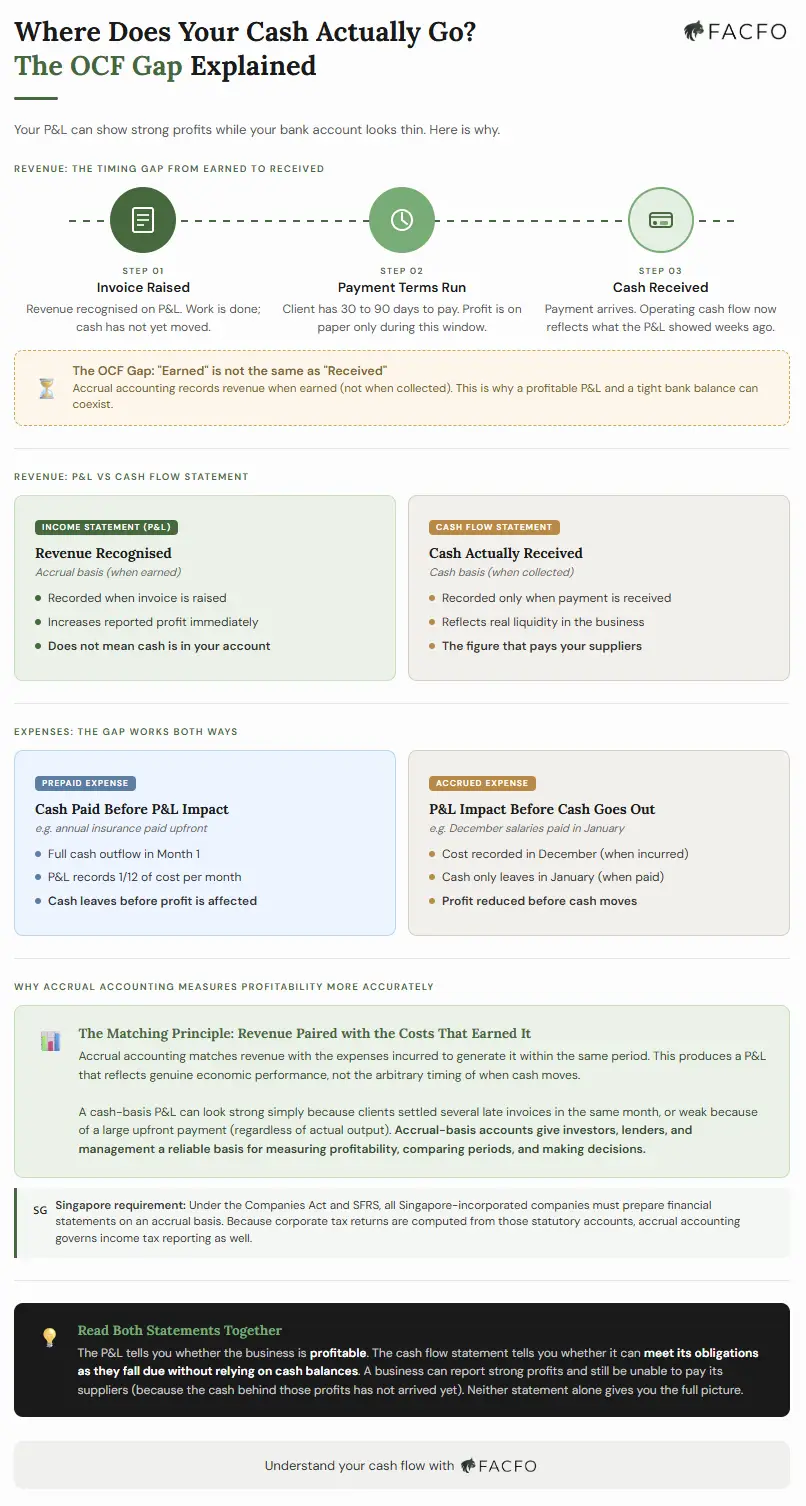
 Consider a straightforward example. Your business invoices a client for £50,000 in December. Your income statement records £50,000 in revenue. But if that client pays in February, your December operating cash flow reflects nothing. The profit is on paper. The cash is not in your account.This timing gap is where businesses get into trouble.