
Many businesses measure their financial performance through revenue growth or profitability. However, neither of these metrics answers a more immediate and critical question: how long can your business continue operating with the cash available today?
This is where burn rate becomes a decision-making tool, not just a financial metric.
At its core, burn rate meaning answers a simple but important question: at your current pace, how long can your business keep operating before it runs out of cash? The answer to that question, which is your runway, can determine whether a business scales successfully or quietly runs into a cash crisis.
Burn rate, along with runway, provides a clear view of a company’s financial sustainability. But as this article will show, the burn rate formula is a starting point rather than the complete picture. Working capital movements and net operating cash flow are what determine how much runway a business actually has in practice. This article explains how burn rate works, how to calculate it more precisely, what it signals, and how to use it to maintain financial control and visibility.
Understanding Burn Rate Beyond the Basics
Burn rate is the amount of cash your business spends each month beyond what it earns. While it is often associated with startups, it is equally relevant for small and mid-sized businesses, particularly those hiring aggressively, investing in growth, or navigating uneven revenue cycles.
There are two ways to look at it:
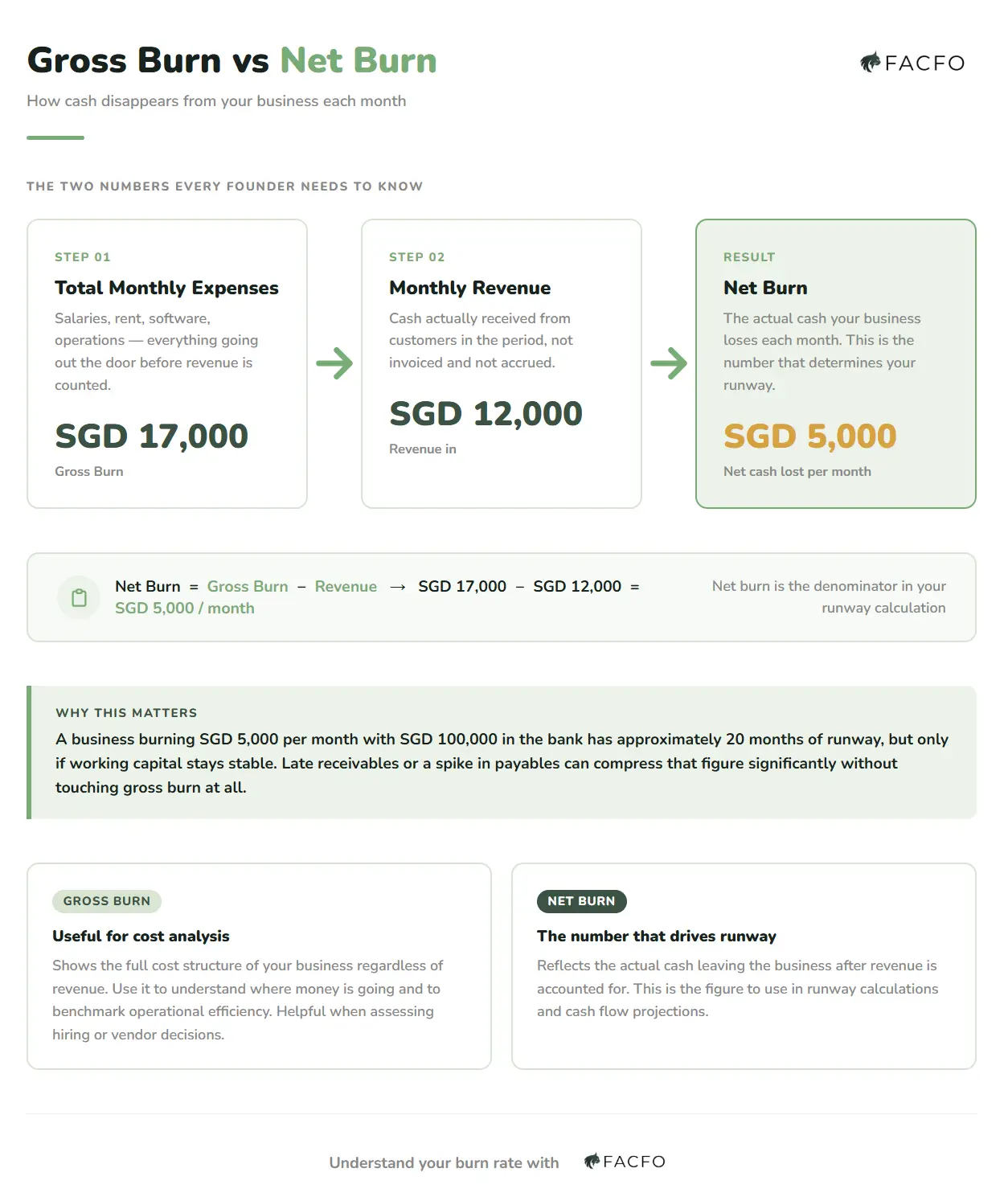
- Gross Burn: your total monthly expenses, including salaries, rent, software, and operational costs.
- Net Burn: the actual cash you are losing each month after accounting for revenue.
For example, if your business spends SGD 17,000 per month and generates SGD 12,000 in revenue, your net burn is SGD 5,000. This is the number that directly determines how long you can stay afloat.
What Is Runway and Why Does It Matter?
Once you know your net burn, you can calculate a first estimate of your runway:
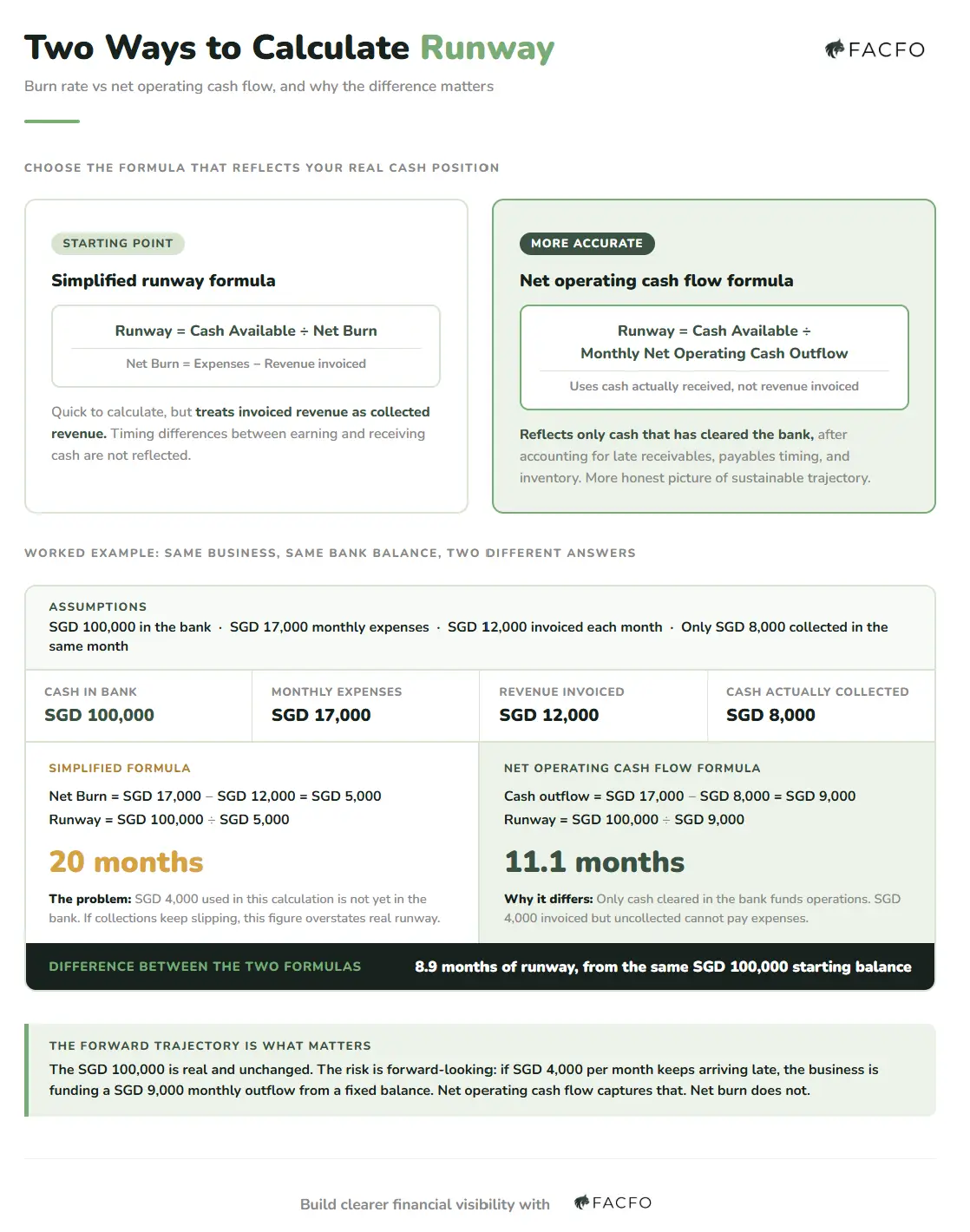
Runway = Cash Available ÷ Net Burn
Using the same example: a business with SGD 100,000 in the bank, spending SGD 17,000 per month and generating SGD 12,000, has a net burn of SGD 5,000 per month. That gives an estimated runway of 20 months.
On paper, 20 months may look comfortable. In practice, this figure is a simplification. It treats cash as if it moves in perfect sync with your income statement. It does not.
A more reliable approach uses net operating cash flow as the denominator:
Runway = Cash Available ÷ Monthly Net Operating Cash Outflow
Net operating cash flow reflects what actually moved through the business after accounting for working capital changes, such as late customer payments, supplier terms, inventory build-up, and similar timing differences. This is why net operating cash flow is the more reliable measure for runway planning: it captures the real cash position rather than the accounting approximation.
Consider what happens when collections lag. Suppose the same business invoices SGD 12,000 each month but only collects SGD 8,000 in the period, with the balance arriving late. Its net operating cash outflow is now SGD 17,000 in expenses less SGD 8,000 collected, or SGD 9,000 per month. On that basis the runway is SGD 100,000 divided by SGD 9,000, roughly 11 months, not the 20 months the simplified formula implies. The bank balance has not changed. What has changed is the recognition that invoiced revenue is not the same as cash received.
The problem is rarely that business owners do not understand runway. It is that many do not revisit it consistently, and most rely on the simpler formula without examining the working capital assumptions underneath it. It is a metric that needs to be periodically monitored.
How Working Capital Affects Your Runway
Working capital is the gap between your current assets and your current liabilities. In practical terms, it is the difference between the cash you are owed and the cash you owe. Movements in working capital can compress or extend your runway significantly, even when your burn rate has not changed.
Consider three common scenarios:
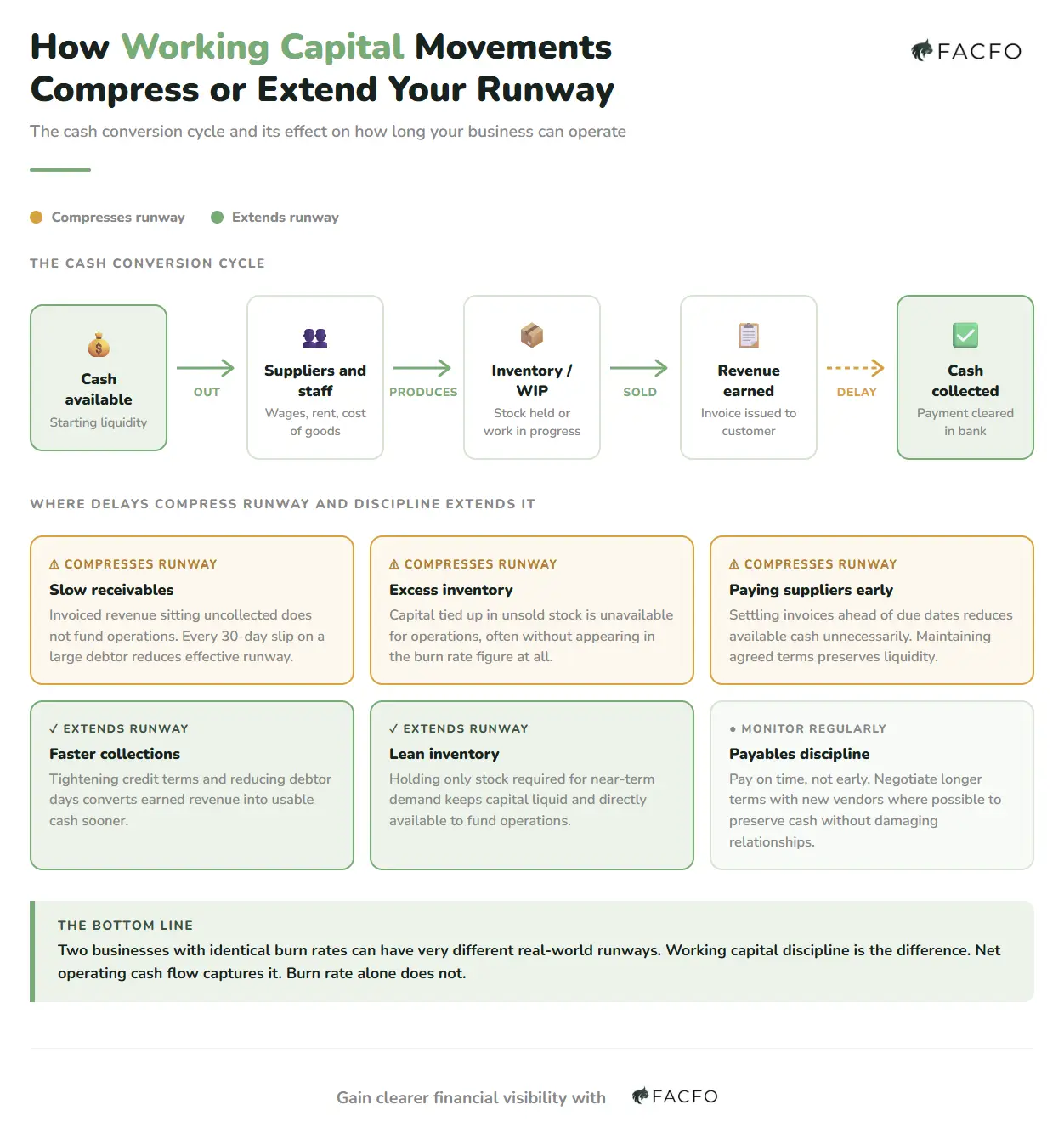
- Accounts receivable: if revenue is invoiced but not collected, it does not fund operations. A business invoicing SGD 12,000 a month but collecting only SGD 8,000 is quietly draining its cash reserves faster than its burn rate suggests. Tightening collections closes that gap and extends runway without any change to spending.
- Accounts payable: paying suppliers earlier than necessary reduces the cash available to fund operations. Negotiating or maintaining longer payment terms where appropriate preserves liquidity without affecting burn rate at all.
- Inventory: for businesses holding stock, capital tied up in unsold goods is capital that is not available to fund operations. Overstocking compresses runway even when revenue looks healthy.
Together, these movements form what is known as the cash conversion cycle. It is the time it takes for cash paid out to suppliers and staff to return as cash collected from customers. The longer the cycle, the more working capital the business needs to sustain operations, and the faster runway shrinks relative to what the burn rate figure implies.
This is why two businesses with identical burn rates can have very different real-world runways. The business with tight receivable collections, disciplined payables, and lean inventory holds its runway. The one with loose credit terms, slow collections, and excess stock sees its runway erode quietly in the background.
Monitoring working capital movements alongside burn rate, and using net operating cash flow as the basis for runway calculations, gives a materially more accurate read on how long the business can sustain its current trajectory.
What Your Burn Rate Is Actually Signalling
Burn rate is not just a financial metric. It is a signal of how your business is actually operating.
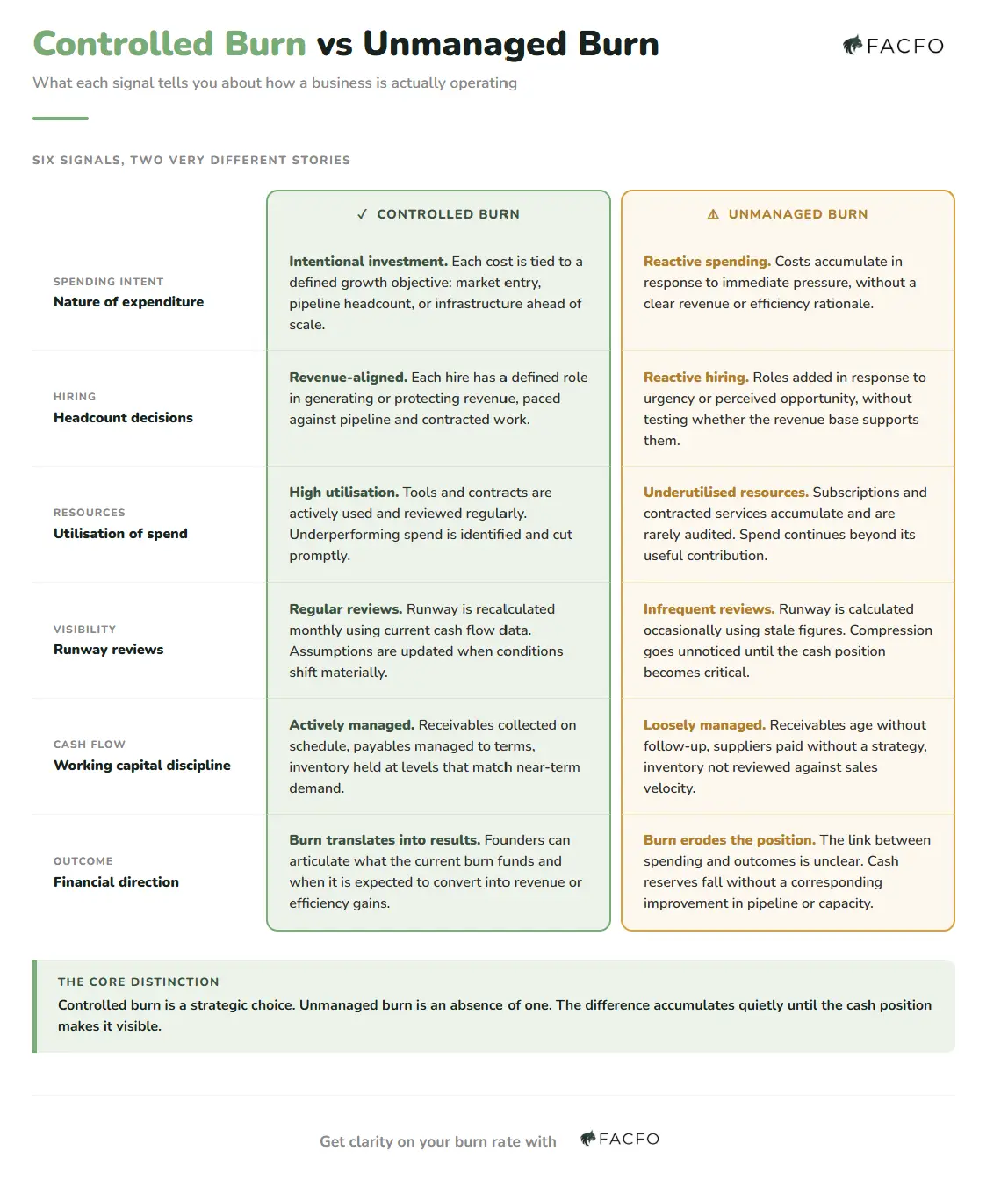
A controlled burn rate often indicates intentional investment. A business expanding into a new market or building a sales team may operate at a higher burn rate temporarily. In these cases, the burn is a strategic choice tied to future growth.
A rising or unmanaged burn rate, on the other hand, usually points to inefficiencies. This could include over-hiring, underutilised resources, or spending that is not directly contributing to revenue.
This is where founders must ask: what does burn rate tell you about your business?
The key difference lies in visibility. Healthy businesses understand why they are burning cash and when that burn will translate into results. Businesses in difficulty typically only recognise the impact when cash reserves have already begun to fall.
The Warning Signs Most Businesses Miss
Burn rate rarely becomes a problem overnight. It builds gradually, often hidden behind growth narratives or operational complexity.
Some of the most common warning signs include:
- Revenue growth is slowing while expenses continue to rise.
- The business is increasingly relying on short-term cash inflows to meet monthly obligations.
- Hiring decisions are being made without clear revenue / profitability alignment.
- Delays in financial reporting are making it difficult to track burn in real time.
- Receivables are ageing and collections are being deprioritised.
In many cases, these signals are visible months before a cash crunch materialises. The issue is not a lack of data. It is a lack of consistent attention to what the data is showing across both the income statement and the cash flow statement.
Using Burn Rate to Make Better Decisions
Burn rate becomes a decision-making tool rather than a retrospective metric when it is reviewed regularly and connected to specific business decisions.
Before making a hiring decision, for example, a founder can work through a short set of questions:
- How will this hire affect our monthly burn?
- How does it change our runway?
- What revenue or efficiency gains justify this cost?
This discipline is also where businesses begin to understand how to manage burn rate effectively, rather than reacting to it after the fact.
Similarly, during periods of uncertainty, burn rate can guide cost optimisation. Rather than broad cuts, businesses can identify which expenses directly affect their survival timeline. This works best when burn rate is combined with financial projections that anticipate future cash flow and structured financial reporting, particularly as businesses scale and require clearer visibility in line with Singapore’s financial reporting requirements.
Why Burn Rate Becomes Critical During Growth
Ironically, many businesses face cash challenges not during slow periods but during growth phases
As companies scale, costs often increase ahead of revenue. New hires, marketing investments, and operational expansion can significantly raise burn rate. At the same time, growing businesses tend to extend credit to new customers, take on more stock, and push supplier payments; all of which stretch the working capital cycle and compress real-world runway further.
Without close monitoring of both burn rate and working capital, a business may find itself in a position where growth looks strong on paper but cash is running short in practice. This is one of the more common, and more avoidable, cash crises that growing SMEs encounter.
There is no universal answer to what a sustainable burn rate looks like. A business raising external capital operates under different constraints than one that is self-funded. What matters is that the burn rate is understood, the working capital position is monitored, and the runway calculation reflects actual cash flow rather than accounting approximations.
This is where bringing in structured financial oversight pays for itself. A fractional CFO in Singapore can build the cash flow models, identify the warning signs early, and give founders the visibility they need to make decisions before a shortfall materialises rather than after.
Conclusion
Burn rate is not just a measure of how much you are spending. It is a measure of how much time you have. But the burn rate formula alone does not tell the full story. Working capital movements, such as slow receivables, tight payables, excess inventory, affect your real cash position independently of what the income statement shows. Net operating cash flow is the more accurate lens for understanding how long your business can sustain its current trajectory.
The difference between businesses that navigate growth well and those that run into cash difficulties often comes down to one thing: how consistently they monitor both burn rate and working capital, and whether their runway calculations reflect reality.